








What is an Abort Test?
In the complex and risky business of space travel, nothing is more important than astronaut safety. An abort test is a simulated emergency designed to prove that the crew can safely escape if the rocket malfunctions during its ascent. For its Gaganyaan
mission, ISRO has developed a Crew Escape System (CES), which acts like a sophisticated ejection seat for the entire crew capsule. In the event of a launch failure, powerful, fast-acting motors are designed to fire and pull the Crew Module, containing the astronauts, away from the failing rocket at incredible speed. This system must work flawlessly within milliseconds to get the crew to a safe distance before any catastrophe.
A High-Altitude Challenge
This recent test was a high-altitude abort test, specifically the Test Vehicle Abort Mission-1 (TV-D1), which presents a more complex scenario than previous tests. Earlier, ISRO had successfully conducted a Pad Abort Test (PAT) in 2018, which simulated an emergency while the rocket was still on the launchpad. The TV-D1 mission, however, tested the escape system during flight, at an altitude of approximately 17 kilometres, while travelling faster than the speed of sound. At this stage, the rocket is under immense aerodynamic pressure, making a successful separation and escape far more challenging. This test proved the system can handle the harsh conditions of a mid-air emergency, a critical requirement for human-rating the launch vehicle.
How the Test Unfolded
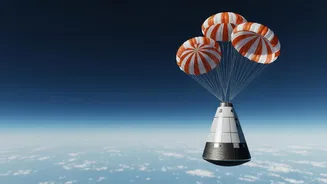
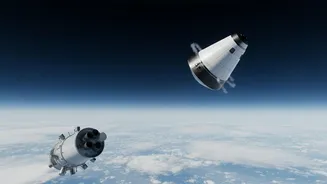
During the TV-D1 mission, a dedicated test vehicle carried the uncrewed Gaganyaan Crew Module and its escape system skyward. At the designated altitude, the abort was deliberately triggered. The Crew Escape System's motors fired, pulling the capsule away from the rocket. After reaching a safe distance, the escape system separated, and a series of parachutes deployed to slow the Crew Module's descent. The entire sequence culminated in a gentle splashdown in the Bay of Bengal, where recovery teams retrieved the capsule. ISRO confirmed that all objectives of the mission were met, validating the performance of the entire escape sequence from launch to recovery.
The Road to Gaganyaan
This successful test is a massive confidence booster for the entire Gaganyaan programme. With the validation of this critical safety system, ISRO moves closer to the next phases of its ambitious plan. The roadmap includes further test vehicle missions like TV-D2, which is already in progress, to refine and re-validate these systems. According to statements from officials, the first uncrewed experimental mission, carrying the humanoid robot Vyommitra, is targeted for the last quarter of 2026. This will be followed by more uncrewed flights before India attempts its first historic crewed mission, which will make it only the fourth country in the world—after the US, Russia, and China—to have an independent human spaceflight capability.
Why This Milestone Matters
Beyond the technical achievement, the success of the high-altitude abort test is a testament to ISRO's meticulous approach to safety. For a mission as prestigious and nationally important as Gaganyaan, the ability to protect the crew in any conceivable scenario is non-negotiable. Each successful test builds the foundation for the final crewed flight, ensuring that when Indian astronauts, or 'Vyomanauts', finally lift off, they are protected by a robust and reliable safety system. It demonstrates that India's journey to the stars is being built not just on ambition, but on a deep-seated commitment to engineering excellence and, above all, the safety of its explorers.