






A Lake's Secret History
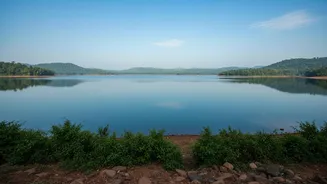
In the heart of India's Core Monsoon Zone, in the Korba district of Chhattisgarh, lies the Raja Rani Lake. To the casual observer, it is a serene landscape. But to scientists, it is a priceless archive. Researchers from the Birbal Sahni Institute of Palaeosciences
(BSIP) in Lucknow have recently delved into this archive by extracting a 40-centimetre-long sediment core from the lakebed. Much like the rings of a tree, these layers of accumulated mud and organic matter contain a continuous record of the region's environmental history, stretching back about 2,500 years. Each layer traps particles from its time—dust, charcoal, and, most importantly, pollen. By carefully analysing these layers, scientists can effectively travel back in time, reconstructing what the world looked like centuries ago.
The Science of Pollen
The key to unlocking the lake's secrets lies in palynology, the scientific study of pollen and spores. Every plant produces pollen with a unique shape and a tough outer wall that allows it to be preserved for millennia in oxygen-poor environments like lake bottoms. The BSIP scientists meticulously isolated these ancient pollen grains from the sediment layers. By identifying the types of plants the pollen came from and counting their abundance, they could paint a detailed picture of the vegetation that thrived around Raja Rani Lake throughout history. The presence of pollen from forest-loving plants, for instance, points to warm and humid conditions, while an abundance of grass pollen might suggest drier phases. This method provides a powerful proxy for understanding past climates without a time machine.
A Stronger, Wetter Past
The analysis revealed a fascinating story. The pollen record showed a dramatic shift in vegetation between roughly 1060 and 1725 CE. During this period, there was a clear dominance of pollen from moist and dry tropical deciduous forest species. This indicates a landscape far lusher and wetter than previously thought for that era, pointing to a significantly stronger and more intense Indian Summer Monsoon (ISM). This period of intense rainfall coincides with a global warm phase known as the Medieval Climate Anomaly (MCA). The researchers attribute this super-charged monsoon to a combination of factors, including La Niña-like conditions in the ocean and increased solar activity, which together amplified rainfall in central India.
Connecting Past and Present Climate
This discovery is more than just a historical curiosity. The study was conducted in India's Core Monsoon Zone, a region that receives up to 90 percent of the country's annual rainfall and is highly sensitive to climate shifts. Understanding how the monsoon behaved during past global climate events like the MCA provides crucial data for climate scientists today. It helps refine the models used to predict future climate trends. The finding that the monsoon system can intensify so dramatically offers a new perspective on its potential variability. This high-resolution palaeoclimatic record helps establish a baseline for natural climate cycles, allowing scientists to better distinguish natural fluctuations from human-induced changes.