



New Eyes on an Ancient Universe
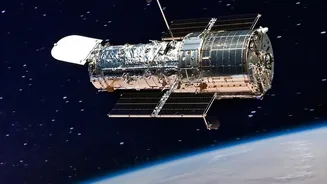
Our ability to peer into the cosmic past has taken a giant leap forward. Instruments like the James Webb Space Telescope (JWST) are engineered to capture light that has traveled for over 13 billion years. This isn't just any light; it's infrared light.
As the universe expands, the light from the most distant objects is stretched from visible and ultraviolet wavelengths into the infrared spectrum. Webb’s unparalleled sensitivity to these wavelengths allows it to cut through cosmic dust and see the universe’s infancy, a period previously shrouded in mystery. This capability moves beyond blurry images, enabling scientists to resolve individual stars and structures within galaxies that existed when the universe was just a fraction of its current age.
Spotting Bars Billions of Years Ago
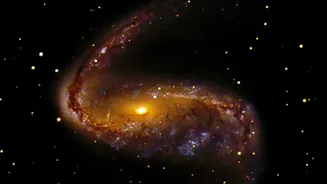
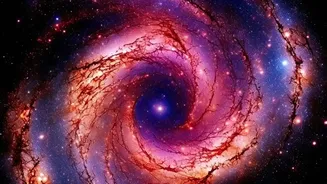
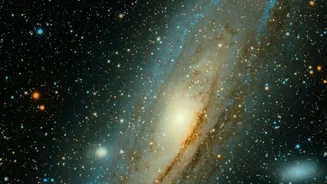
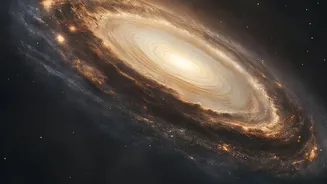
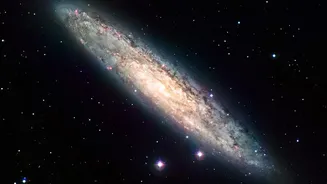
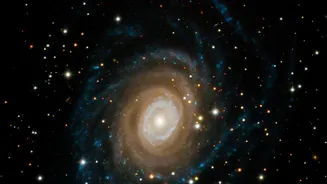
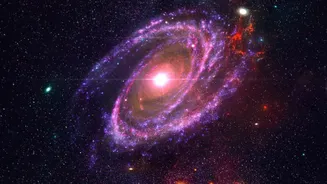
One of the most surprising discoveries is the existence of 'barred' galaxies far earlier than predicted. A barred galaxy, like our own Milky Way, has a large, linear structure of stars running through its center. These bars are considered signs of a mature, well-organized galaxy, as they are formed by complex gravitational dynamics that take time to develop. Astronomers previously thought the early universe was mostly populated by messy, turbulent, and irregular galaxies. However, multiple teams have now used JWST to identify distinct barred galaxies that existed when the universe was only about two billion years old. Finding these highly evolved systems so early challenges the timeline for galactic evolution, suggesting that the process of becoming an organized galaxy can happen much faster than models suggested.
Rewriting the Cosmic Timeline
These advanced structures are not just cosmic curiosities; they force a fundamental rethink of galaxy formation. The presence of bars is significant because they act like cosmic highways, funneling gas and dust from the outer disks of a galaxy toward its center. This process can fuel intense star formation and feed the supermassive black hole lurking at the galactic core, accelerating the galaxy's evolution. The discovery that these mechanisms were in place so early helps explain another JWST finding: many early galaxies appear far more massive, bright, and chemically mature than they should be for their age. Some have even been observed to have stopped forming stars altogether, suggesting they lived fast and died young. These 'impossible' galaxies indicate that something crucial might be missing from our understanding of how the universe's first structures were built.
From Faint Light to Grand Structures
Identifying these hidden patterns is a monumental task that combines observation with sophisticated analysis. Astronomers use Webb’s spectroscopic instruments to analyze the light from these distant objects, which reveals information about their chemical composition, temperature, and motion. For instance, by measuring how light has been stretched by the expanding universe—a phenomenon known as redshift—they can accurately determine a galaxy’s distance and age. In some cases, they use a natural magnifying glass called gravitational lensing, where the gravity of a massive foreground object, like a galaxy cluster, bends and amplifies the light from a more distant galaxy behind it, bringing otherwise invisible details into view. This combination of powerful technology and cosmic alignment is giving us our first clear look at how the universe became the structured and complex place we see today.