




The Cosmic Data Deluge
For decades, NASA's missions have been gathering an extraordinary amount of information. Across its programs in aeronautics, planetary exploration, and Earth observation, the agency has collected over 150 petabytes of data—an almost incomprehensible volume.
To put that in perspective, if this data were stored on standard DVDs, the stack would be thousands of feet high. This number is set to grow exponentially, with Earth science data alone projected to reach 600 petabytes by the early 2030s. While this archive represents a treasure trove of potential discoveries, its sheer scale makes it impossible for human researchers to manually analyze every observation. This information bottleneck risks slowing the pace of science, as valuable insights could remain buried in the noise.
AI as a Digital Research Partner
Artificial intelligence, specifically machine learning, offers a powerful solution to this data overload. These systems can be trained to recognize patterns, anomalies, and specific features within enormous datasets at speeds no human could match. Think of it as a highly specialized research assistant capable of sifting through millions of images or data points to flag something of interest. For instance, NASA's ExoMiner, a deep learning system, analyzed data from the Kepler Space Telescope and successfully identified 301 previously overlooked exoplanets. In Earth science, AI models are being used to analyze decades of satellite imagery to monitor deforestation, track harmful algal blooms, and improve weather and climate forecasting. This doesn't replace human scientists; it empowers them by handling the heavy lifting of data processing, freeing them to focus on interpretation and analysis.
From Solar Flares to Martian Rovers
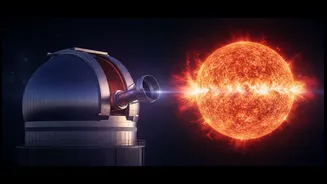
The applications of AI at NASA are diverse and expanding rapidly. In heliophysics, a new AI model named 'Surya'—the Sanskrit word for the Sun—is being trained on years of data from the Solar Dynamics Observatory. Its goal is to better predict space weather events like solar flares, which can disrupt power grids and communication satellites on Earth. Far from home, AI is giving rovers on Mars unprecedented autonomy. The Perseverance rover uses AI to navigate the hazardous Martian terrain in real-time without constant input from mission control, making its exploration far more efficient. This capability is crucial for future deep space missions where communication delays make manual control impractical. Other AI systems are being developed to monitor spacecraft health, predict system failures, and even help astronauts navigate on the lunar surface.
A New Era of Discovery
By integrating AI into its workflows, NASA is not just speeding up existing research methods; it's enabling entirely new kinds of science. In July 2026, the agency announced its formal participation in the Genesis Mission, a national initiative to leverage AI for major scientific challenges. A key goal is to connect data from different missions and fields of study, allowing AI to find hidden relationships that span across astronomy, Earth science, and even biology. This holistic approach could unlock systemic insights into our planet and the universe. The ultimate vision is a future where AI and human scientists work in a symbiotic partnership. AI can identify promising leads in the data, and human experts can apply their creativity and intuition to explore those leads, ask new questions, and drive the next wave of cosmic discovery.