






The Quantum Conundrum
Quantum mechanics is arguably the most successful scientific theory in history. It describes the subatomic world with breathtaking accuracy, and its principles underpin everything from the smartphone in your pocket to the medicines in your cabinet. Yet,
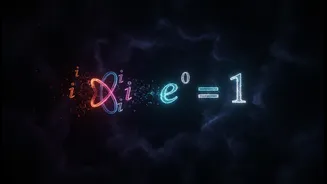
for all its success, it remains deeply counterintuitive. It tells us that particles can be in multiple places at once (superposition) or instantly connected across vast distances (entanglement). A core reason for this weirdness is the mathematics it uses. From its inception in the 1920s with physicist Erwin Schrödinger, the theory's fundamental equations have relied on complex numbers. These are numbers that have two parts: a 'real' part and an 'imaginary' part, the latter involving the square root of -1, famously represented by the symbol 'i'. This has always been a puzzle, as the things we actually measure in the real world—position, energy, time—are always real numbers, not imaginary ones.
Are 'Imaginary' Numbers Necessary?
This reliance on 'i' has led to a century-long debate: are complex numbers truly fundamental to reality, or just a convenient mathematical tool? For a long time, many physicists, including Schrödinger himself, viewed them as a computational shortcut—clumsy to avoid, but not necessarily essential. However, proving this has been difficult. In 2021, a significant study suggested complex numbers were, in fact, unavoidable. It proposed an experiment where a theory based only on real numbers would make different predictions than standard quantum mechanics. Subsequent experiments matched the standard theory, seemingly closing the case and confirming that the quantum world truly has an imaginary component. This reinforced the idea that the strangeness of quantum behaviour was fundamentally tied to the strangeness of its underlying numbers.
A 'Real' Alternative Emerges
However, the debate is far from over. Very recently, in a paper published in Physical Review Letters, a team of physicists challenged that conclusion. They argue that the 2021 result was based on a specific, and not necessarily universal, assumption about how to combine quantum systems. By adopting a different rule, they successfully constructed a version of quantum mechanics using only real numbers that makes all the same predictions as the standard theory. Pedro Barrios Hita, a doctoral student and first author of the study, stated that complex numbers are not needed for quantum mechanics. Their approach essentially treats a complex number as what it is: a pair of real numbers. They developed a 'bookkeeping' system to track these two parts separately, showing that the 'imaginary' component isn't fundamental, but rather a convenient label.
What Would Simplification Change?
If this real-number formulation holds up, what does it actually change? In the short term, not much for practical applications. The new framework doesn't predict any new experimental outcomes or open the door to new technologies overnight. Its primary impact is conceptual. For one, it could make the theory easier to teach and grasp, stripping away a layer of mathematical abstraction that has baffled students for generations. More profoundly, it settles a long-standing philosophical debate about the nature of reality. It suggests the universe isn't built on imaginary components after all; they are just helpful tools we've used to describe it, much like in other fields such as electromagnetism. This new perspective could offer a clearer lens through which to tackle the remaining big mysteries of physics, like unifying quantum mechanics with gravity.
A Healthy Dose of Scepticism
While this new development is exciting, it’s important to maintain perspective. The standard, complex-number version of quantum mechanics has worked flawlessly for a century. It remains compact and computationally elegant, while the real-valued alternatives can be more cumbersome. The new work is also currently limited to certain types of quantum systems and needs to be extended to more complex scenarios. As such, the physics community isn't about to abandon its textbooks just yet. Most physicists will likely continue to use complex numbers because they are an incredibly effective and streamlined tool. However, the new research provides a powerful reminder that even our most successful theories should be questioned and that the quest for a simpler, more intuitive description of the universe is a driving force of science.