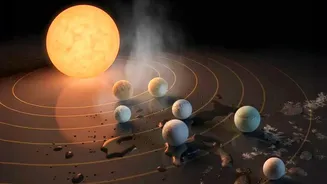


The solar system feels permanent, a clockwork of planets in stable, predictable orbits. But new research into the Sun's distant future paints a far more chaotic picture, one where even a giant like Saturn could be violently thrown out.
The Sun's Final Act
Our Sun, like all
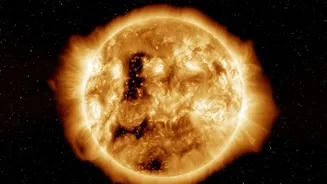
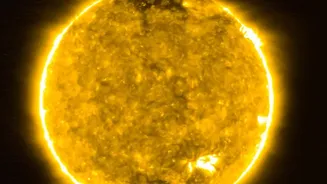
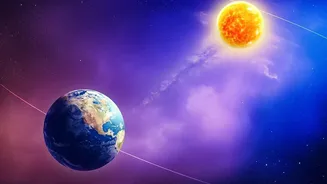
stars, has a finite lifespan. For the past 4.6 billion years, it has been in its main sequence, fusing hydrogen into helium in its core. This process provides the energy that sustains life on Earth. But in about five billion years, that hydrogen fuel will begin to run out. The Sun will then start to swell dramatically, entering its red giant phase. Over the course of another billion years or so, it will expand to hundreds of times its current size, engulfing the inner planets Mercury and Venus. Earth's fate hangs in the balance, with scientists divided on whether it will be swallowed or left a scorched, lifeless rock.
A New, Lighter Star
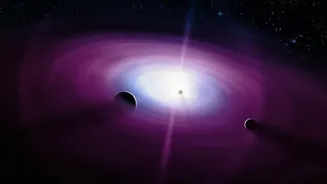
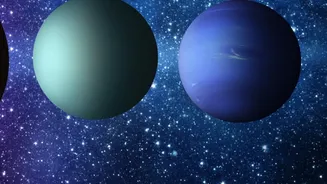
After this violent expansion, the Sun will shed its outer layers, creating a beautiful planetary nebula. What remains will be its dense, collapsed core: a white dwarf. This stellar remnant will be roughly the size of Earth but contain about half of the Sun's current mass. For decades, the prevailing theory was that this mass loss would be a smooth, gradual process. As the Sun's gravitational pull weakens, the surviving outer planets—Jupiter, Saturn, Uranus, and Neptune—were expected to drift into wider, but still stable, orbits. They would continue to circle the dead Sun for billions, or even trillions, of years.
The Great Unsettling
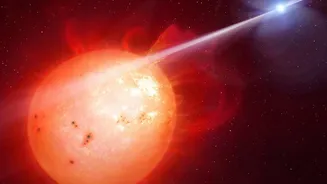
However, recent research has thrown this peaceful picture into doubt. A new study published in The Astrophysical Journal Letters suggests the Sun's mass loss won't be smooth at all. Instead, it may happen in a series of jerky, uneven bursts, like giant cosmic coughs. Each of these explosive events would give the dying Sun a small push, or a 'recoil kick'. While each individual kick is tiny, thousands of them over millions of years would accumulate, slowly nudging the Sun and disrupting the delicate gravitational balance of the entire outer solar system.
Chaos Among the Giants
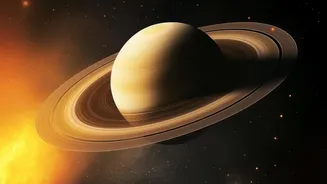
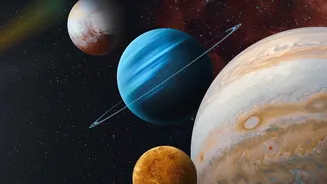
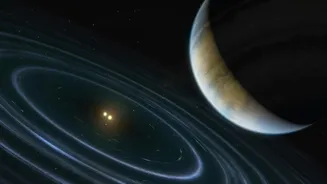
To understand the consequences, researchers ran hundreds of computer simulations. The results were dramatic. Instead of settling into placid new orbits, the giant planets were thrown into chaos. The simulations showed their orbits becoming wildly elongated and crossing each other's paths. In some scenarios, Uranus and Neptune even switched places. This new model drastically shortens the timeline for the solar system's stability, from a near-eternal timescale down to just a few billion years after the Sun becomes a white dwarf.
Saturn's Shocking Exit
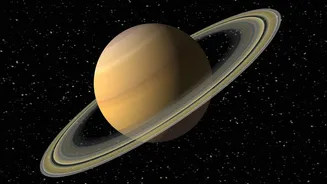
The most startling outcome in some of these simulations was the ejection of entire planets. Saturn was sometimes thrown out of the solar system completely, sent careening alone into the vastness of interstellar space. In the most extreme simulations, where the Sun's mass loss was most violent, this instability led to catastrophic collisions. In a staggering 96% of these high intensity scenarios, the giant planets crashed into each other and were destroyed. While these are simulations of a possible future they reveal that the final chapter of our solar system could be far more violent than we ever imagined.