






What Exactly Is El Niño?
At its core, El Niño is a natural climate phenomenon characterized by the unusual warming of the sea surface in the central and eastern equatorial Pacific Ocean. The name, meaning "The Little Boy" in Spanish, was given by fishermen off the coast of South
America who noticed the warming around Christmas. This warming occurs irregularly, typically every two to seven years. Under normal conditions, strong trade winds blow from east to west, piling up warm water in the western Pacific near Asia and Australia. During an El Niño event, these trade winds weaken, allowing the vast pool of warm water to shift eastward, toward the coast of South America. This isn't just a minor temperature change; it's a massive redistribution of oceanic heat that sets off a chain reaction in the atmosphere above it, altering weather patterns on a global scale.
The Domino Effect on India's Monsoon
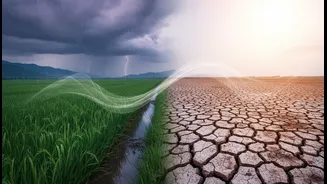
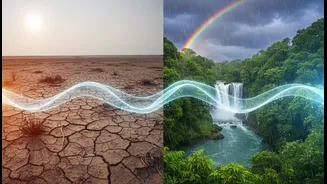
India's economy and the livelihoods of millions are deeply intertwined with the annual southwest monsoon, which provides about 70-75% of the country's rainfall. El Niño has a strong tendency to disrupt this vital weather system. The warming of the eastern Pacific Ocean changes the atmospheric pressure balance. Normally, the western Pacific is a low-pressure zone that helps draw moisture-laden winds towards the Indian subcontinent. During an El Niño, this pressure system weakens and shifts eastward. This change can suppress the development of monsoon clouds and reduce the flow of moisture over India, often leading to below-normal rainfall and, in severe cases, drought-like conditions. Historically, many of India's most severe droughts have occurred during El Niño years, though not every El Niño year results in a drought.
From Barren Fields to Rising Prices
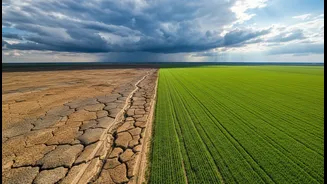
The most immediate and severe impact of a weak monsoon is on agriculture, a sector that employs a significant portion of India's workforce. Deficient rainfall during the critical Kharif sowing season can lead to lower crop yields for staples like rice, pulses, oilseeds, and cotton. Rainfed agricultural regions are particularly vulnerable. This agricultural distress doesn't just stay on the farm. A drop in production can lead to food shortages, forcing the government to draw from buffer stocks or increase imports. Consequently, food inflation often follows a poor monsoon, affecting household budgets across the nation. Reduced farm income also dampens rural demand for goods and services, creating a ripple effect that can slow down overall economic growth.
Water Scarcity and Searing Heat
Beyond agriculture, the effects of a weak, El Niño-influenced monsoon are widespread. Lower rainfall means less water to replenish reservoirs, rivers, and groundwater tables. This strains water availability not just for irrigation but also for drinking water in cities and villages, and for industrial use. Hydropower generation, which depends on adequate reservoir levels, can also be impacted. Furthermore, El Niño years are often associated with warmer-than-average temperatures and more intense heatwaves across India. This combination of less rain and more heat intensifies water stress and can have serious public health consequences.
La Niña: The Other Side of the Coin
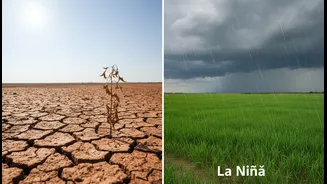
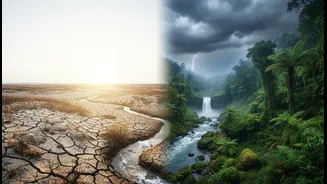
The climate cycle also has an opposite phase: La Niña, or "The Little Girl." This is when the sea surface temperatures in the same region of the Pacific become cooler than normal. La Niña's effects are often the reverse of El Niño's. For India, it is typically associated with stronger monsoons and above-normal rainfall, which is generally beneficial for agriculture. For example, 2020, 2021, and 2022 were La Niña years that saw robust monsoons, contrasting with the below-normal rains in the El Niño year of 2023. This entire cycle is known as the El Niño-Southern Oscillation (ENSO), a natural and powerful driver of global climate variability.