


An Aging Titan of the Cosmos
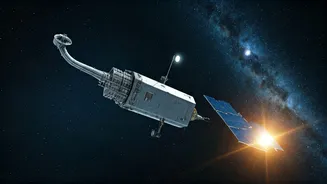
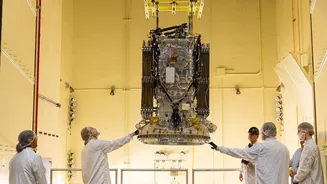
For over two decades, the Neil Gehrels Swift Observatory has served as humanity’s cosmic first responder. Launched in 2004, its mission is to hunt for gamma-ray bursts (GRBs)—the most powerful and fleeting explosions known in the universe, often signaling
the birth of a black hole. True to its name, the observatory was engineered to pivot with incredible speed. Upon detecting a GRB, it can autonomously reorient its powerful X-ray and ultraviolet/optical telescopes to the source in under 90 seconds. This unique ability has allowed scientists to study the fading afterglow of these cataclysmic events in unprecedented detail, solving longstanding mysteries about their origins. Beyond GRBs, Swift has become a versatile tool for observing everything from supernovae to comets, making it one of the most productive astrophysics missions ever flown.
A Slow, Inevitable Fall
Despite its scientific successes, Swift has been battling a fundamental force: gravity. Positioned in a low-Earth orbit, it has always been subject to faint atmospheric drag. However, a recent surge in solar activity, part of the sun’s natural cycle, has caused Earth’s upper atmosphere to expand, or “puff up.” This has dramatically increased the drag on the satellite, causing its orbit to decay much faster than anticipated. Having dropped from its original 600-kilometer altitude, the observatory is now on a trajectory that would see it burn up upon reentry into the atmosphere sometime in mid-to-late 2026. Complicating matters, Swift was not built with its own propulsion system to counteract this decay, leaving it with no way to save itself. Ground controllers have taken measures to minimize drag and buy time, but without outside help, its fate is sealed.
Enter the Robotic Tugboat
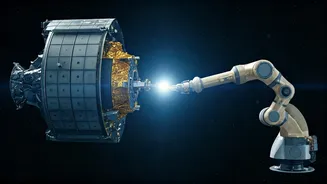
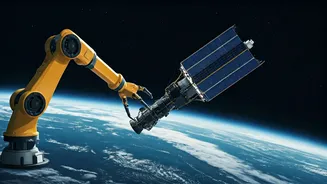
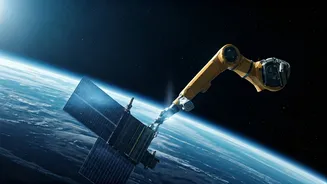
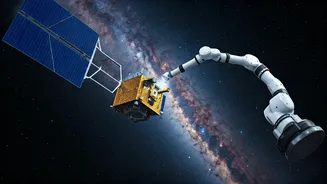
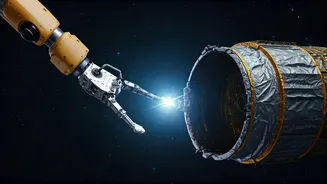
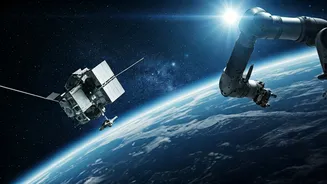
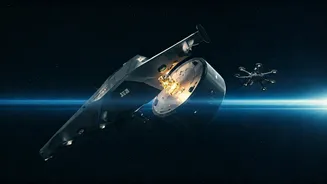
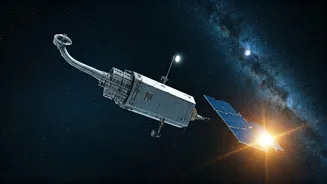
Rather than letting the valuable observatory perish, NASA has opted for a bold and innovative solution: a robotic rescue. In an unprecedented move, the agency awarded a $30 million contract to Katalyst Space Technologies, a private U.S. startup, to mount a salvage operation. Katalyst has developed a robotic servicing spacecraft named LINK, designed to act as a celestial tugboat. The plan is for LINK to launch, rendezvous with Swift, and use its three robotic arms to carefully grab onto the observatory—a delicate maneuver, as Swift was never designed for docking or in-orbit servicing. Once it has a secure hold, LINK will use its own gentle thrusters to slowly and carefully boost the combined spacecraft back up to a higher, more stable orbit, effectively giving Swift a new lease on life.
High-Stakes Launch Delays
The mission is a high-stakes race against the clock, and the drama has been palpable. The launch of the LINK spacecraft, aboard a Northrop Grumman Pegasus XL rocket released from a carrier aircraft, was scheduled for early July 2026 from the Marshall Islands. However, the initial launch attempts were scrubbed. The first was postponed due to unfavorable weather, and a subsequent attempt on July 2 was called off because of an issue with the launch vehicle itself. With Swift's orbital window slowly closing, the teams are now analyzing the data to determine a new launch date. The postponements add another layer of tension to a mission where timing is critical to success.
More Than Just One Satellite
The mission's success or failure carries implications far beyond the fate of a single telescope. For NASA, spending $30 million to save an asset that cost hundreds of millions and is still scientifically invaluable is a sound investment. But more broadly, this is a pivotal test for the emerging commercial industry of on-orbit servicing. A successful rescue would prove that aging but otherwise functional satellites can be repaired, refueled, or repositioned, shifting the paradigm from disposable space assets to sustainable ones. This capability could one day be applied to other crucial observatories, such as the Hubble Space Telescope, which is also losing altitude. By entrusting this critical task to a private company, NASA is helping to seed a new commercial market that could fundamentally change how we operate in space.