




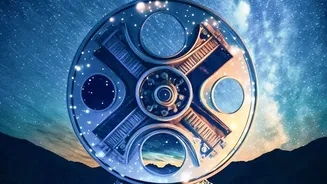
Inception (2010)
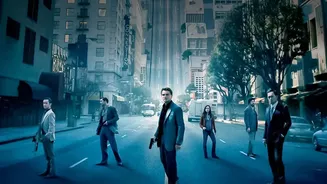
Christopher Nolan's magnum opus took the simple idea of sharing dreams and layered it into a complex, high-stakes heist. The film introduces a world where technology allows corporate spies to extract information from a person's subconscious. But the real
mind-bender is 'inception'—planting an idea so deep it feels organic. With its rules about time dilation in multi-level dreamscapes and the iconic, perpetually spinning top, the movie forces you to question every scene's reality. Its ambiguous ending is the final masterstroke, leaving audiences in a permanent state of debate about what is real and what is a dream.
The Matrix (1999)
Before 'red pill' became a cultural meme, it was a choice offered to Neo in a film that redefined sci-fi for a new generation. The Matrix presents a dystopia where humanity is unknowingly trapped in a simulated reality, while their bodies are used as an energy source for intelligent machines. The movie blends high-concept philosophy about choice and perception with groundbreaking, physics-defying action sequences. It didn't just ask, "What if this world isn't real?"; it showed us the terrifying and exhilarating possibility of breaking free, making it an essential entry in the canon of reality-questioning cinema.
Interstellar (2014)
Another Nolan masterpiece, Interstellar tackles the vastness of space and the elasticity of time head-on. As Earth faces an agricultural apocalypse, a team of astronauts travels through a wormhole to find a new habitable planet. The film beautifully and terrifyingly visualizes Einstein's theory of relativity, where hours spent on one planet equate to decades back on Earth. The emotional weight of this time dilation, particularly for the protagonist Cooper and his daughter, is devastating. Its climax, involving a five-dimensional tesseract, reframes time not as a linear path but as a physical place, creating a story that is as much about love and human connection as it is about astrophysics.
Arrival (2016)
Unlike most alien invasion films, Arrival is not about conflict but communication. When extraterrestrial ships appear across the globe, linguist Louise Banks is tasked with deciphering their language. The film’s genius lies in its exploration of the Sapir-Whorf hypothesis—the idea that the language you speak determines your perception of the world. As Louise becomes more fluent in the aliens' non-linear language, her perception of time begins to shatter. The narrative unfolds in a way that brilliantly mirrors her experience, revealing that what we perceive as flashbacks are actually flash-forwards. It’s a poignant, cerebral film that uses language to question the linear nature of our existence.
Blade Runner (1982)
Set in a rain-drenched, dystopian Los Angeles in 2019, Blade Runner explores profound questions of identity and what it means to be human. The story follows Rick Deckard, a 'blade runner' whose job is to hunt and 'retire' bioengineered androids called replicants. These replicants are virtually indistinguishable from humans, complete with implanted memories that make them believe they are real. The film's slow, atmospheric pace and philosophical core force the audience to ponder: if a being has memories, emotions, and a fear of death, are they any less human than their creator? The ambiguity surrounding whether Deckard himself is a replicant makes this a timeless masterpiece on the fragility of identity.