

The Power of a Panoramic View
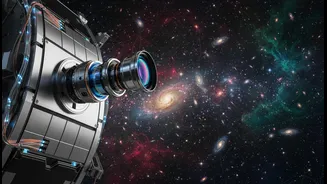
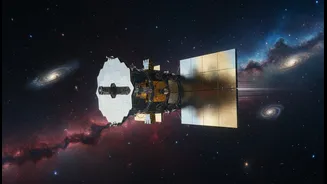
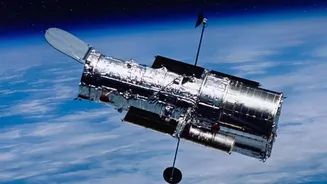
While the Hubble and James Webb space telescopes are renowned for their sharp, deep-field images of small patches of sky, Roman is designed for breadth. Its primary mirror is the same size as Hubble's, but its Wide Field Instrument (WFI) gives it a field of view
100 times larger. This means that in a single snapshot, Roman can capture an area of the sky that would require hundreds of individual images from Hubble. It’s the difference between studying a single tree in detail and mapping the entire forest at once. This survey power is what makes Roman a game-changer; it's built to create vast cosmic maps with incredible speed and efficiency, gathering data on a scale never before possible.
Chasing the Universe's Biggest Mysteries
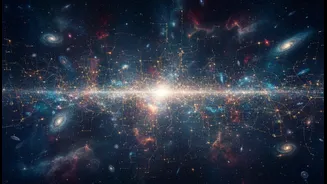
Approximately 68% of the universe is composed of dark energy, a mysterious force causing the universe's expansion to accelerate, with another 27% being equally enigmatic dark matter. Understanding these phenomena is one of the most fundamental challenges in modern physics. Roman’s primary mission is to tackle this head-on. By surveying billions of galaxies across cosmic time, the telescope will map the large-scale structure of the universe. Scientists will analyze how galaxies are clustered and how their light has been distorted by dark matter through a process called weak gravitational lensing. These vast datasets will help trace the expansion history of the universe, providing crucial clues about the true nature of dark energy and whether Einstein's theory of gravity needs revision.
A New Frontier in Planet Hunting
Roman is also set to dramatically expand our catalogue of worlds beyond the solar system. While NASA's Kepler and TESS missions have found thousands of exoplanets using the 'transit' method (detecting a dip in starlight as a planet passes in front), Roman will primarily use a different technique called gravitational microlensing. This method relies on a prediction from Einstein's theory of relativity: the gravity of a foreground star and its planets can bend and magnify the light from a distant background star. This technique is especially sensitive to planets that are further from their star, in or beyond the habitable zone, and even free-floating 'rogue' planets that don't orbit a star at all. Scientists expect Roman to discover thousands of new exoplanets, including many analogues to the planets in our own solar system, filling a critical gap in our understanding of planet formation.
Technology Demonstrator and Data Factory
Beyond its primary survey work, Roman carries a second instrument: the Coronagraph. This instrument is a technology demonstration designed to block the overwhelming glare of a star, making it possible to directly image the faint planets orbiting it. It is expected to be 100 to 1,000 times more powerful than previous space-based coronagraphs, paving the way for future missions like the Habitable Worlds Observatory that aim to characterize Earth-like planets. The sheer volume of data Roman will generate is staggering. Its surveys will create a treasure trove of information that astronomers around the world will mine for decades, leading to discoveries far beyond the mission’s initial goals, from studying supermassive black holes to finding small bodies in our own solar system.