
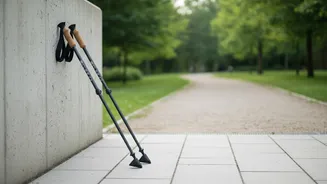

More Than Just a Walk With Sticks
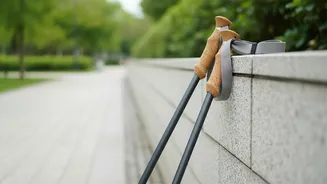
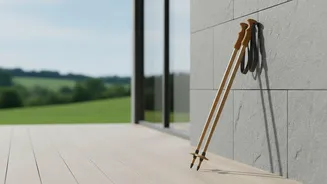
At first glance, Nordic walking might look like hiking or simply walking with poles for balance. But it's a specific fitness technique with origins in Finland, where it was developed as a summer training method for cross-country skiers. It involves using
specially designed poles to actively propel yourself forward. As you walk, you plant the poles behind you and push off, engaging your upper body in a way that regular walking doesn't. This transforms a lower-body-focused activity into a full-body workout, activating up to 90% of your body's muscles, including your arms, shoulders, chest, and core. The result is a surprisingly efficient workout that burns significantly more calories—up to 46% more—than walking normally at the same pace.
The Shift to Everyday Fitness
The modern fitness world is often dominated by high-intensity interval training (HIIT), heavy lifting, and marathon goals. While effective, this approach can feel intimidating, unsustainable, or inaccessible for many. Nordic walking represents a different philosophy: integrating meaningful movement into everyday life. Because it's a low-impact activity, it’s much kinder to your joints, particularly the knees and hips, than running. This makes it an ideal exercise for a wide range of people, including older adults, those recovering from injuries, or anyone who finds high-impact exercise painful. The poles also provide extra stability, boosting confidence on uneven ground. It is this accessibility that positions Nordic walking not as a gruelling session to be endured, but as a pleasant and sustainable activity that can be done consistently.
The Classic Case for Gradual Training
A cornerstone of exercise science is the principle of gradual training, often called 'progressive overload'. The idea is simple: to get stronger or fitter, you must continually challenge your body by gradually increasing the demands you place on it. In a gym setting, this usually means lifting heavier weights, doing more repetitions, or running faster or for longer. This principle works because it forces the body to adapt and grow stronger to handle the new stress. However, if the progression is too fast, it can lead to burnout or injury; if it's too slow, you might hit a plateau. This is the tightrope many fitness enthusiasts walk.
A Gentler, Smarter Progression
Nordic walking doesn't discard the principle of gradual training; it reframes it. Instead of focusing solely on intensity, progression in Nordic walking is more holistic. Beginners might start by simply learning the correct technique, ensuring the opposite arm and leg move in coordination while maintaining an upright posture. From there, progress isn't just about 'more'. It can mean increasing the duration of your walks, going out more frequently, or tackling more challenging terrain like hills. You can also progress by focusing on technique and power—pushing more forcefully through the poles to increase speed and muscle engagement. This creates a softer, more sustainable ramp-up. The goal shifts from constantly pushing to your absolute limit to finding a consistent, enjoyable rhythm that builds fitness over time without the high risk of injury associated with more aggressive training styles.
Finding Your Stride in India
The simplicity and accessibility of Nordic walking make it particularly well-suited for India. It requires minimal equipment—just a good pair of walking shoes and the poles—and can be done in local parks, on promenades, or within residential complexes. For busy professionals, it offers an efficient full-body workout that can be fit into a morning or evening routine. For older adults, it provides a safe way to stay active, improve balance, and maintain muscle strength. As a community-focused activity, it's also a great way to socialise while exercising. While still a growing movement in India, its benefits for heart health, weight management, and joint-friendly exercise are gaining recognition.