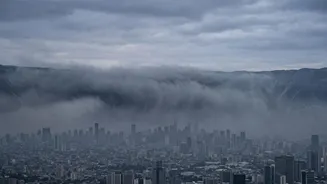







Every resident of the NCR knows the daily ritual of checking the AQI. But why does the air quality swing from 'poor' to 'severe' so quickly? The answer lies not just in pollution sources, but in the invisible hand of local weather patterns.
The Chokehold of Calm Winds
Wind is the
most straightforward factor influencing daily air quality. Think of the atmosphere over the NCR as a giant room. When strong winds blow, they act like a massive fan, dispersing pollutants and carrying them away from the city. This ventilation is why a windy day often brings clearer skies and a lower AQI reading. Conversely, when wind speeds are low or calm, the 'fan' is switched off. Pollutants from vehicles, industry, and stubble burning get trapped, causing their concentration to build up rapidly and sending the AQI into the 'very poor' or 'severe' categories. A ventilation index below 6,000 m²/s and wind speeds under 10 kmph are considered unfavourable for dispersing pollutants.
Temperature Inversion: A Lid on the City
Perhaps the most critical weather phenomenon during NCR's pollution season is the temperature inversion. Normally, air is warmer near the ground and gets cooler with altitude, allowing warm, polluted air to rise and mix with cleaner air above. In winter, this pattern flips, especially during the night and early mornings. A layer of warmer air forms high above, trapping a layer of colder, denser air near the ground. This acts like an invisible lid, preventing pollutants from escaping. The height to which air can mix, known as the mixing height, can shrink from over a kilometre in summer to just a few hundred metres in winter, concentrating all the pollution in a much smaller volume of air. This is why AQI levels often spike overnight and in the early morning.
Humidity and the Making of Smog
Humidity, or the amount of moisture in the air, plays a complex role. High humidity can make the air feel heavier and aids in the formation of smog. Water vapour in the air can attach to particulate matter (like PM2.5), making these particles larger and heavier. This prevents them from dispersing easily and contributes to the thick, hazy conditions often seen on polluted days. Furthermore, certain chemical reactions that form secondary pollutants—harmful particles not emitted directly but formed in the atmosphere—are influenced by humidity levels. Studies have shown that the concentration of PM2.5 has an inverse relationship with temperature, particularly during high humidity conditions.
The Role of External Pollutants
While local emissions are a constant problem, weather patterns are also responsible for transporting pollution from hundreds of kilometres away. During the post-monsoon and winter season, northwesterly winds carry smoke from agricultural stubble burning in Punjab and Haryana directly towards the NCR. When these winds are strong, the smoke can pass over quickly. However, when the winds become slow and are combined with a temperature inversion over Delhi, the smoke gets trapped and accumulates, leading to a dramatic spike in pollution levels. This highlights how Delhi’s air quality is not just a local issue but a regional one, heavily dependent on wind direction and speed.
Rainfall: The Atmosphere's Reset Button
Rainfall acts as a natural cleanser for the atmosphere. Rain droplets capture and wash away particulate matter and other pollutants suspended in the air, a process known as 'wet deposition'. This is why the air often feels exceptionally clean and the AQI drops into the 'satisfactory' or even 'good' category immediately following a good shower. While not a solution, it demonstrates the powerful effect meteorological conditions have on the air we breathe.