




The Grand Ambition: A Lunar Souvenir
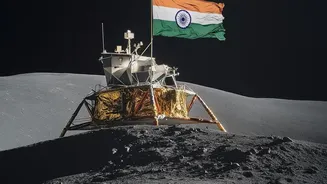
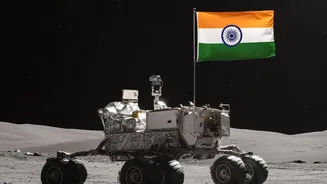
The primary goal of Chandrayaan-4 is to achieve what only a handful of nations have done before: perform a lunar sample-return mission. The plan is to land near the Moon's south pole, a region of immense scientific interest, collect up to 3 kilograms
of lunar soil (regolith) and subsurface material, and transport it safely back to Earth for analysis. These samples are invaluable. Unlike remote analysis, studying them in terrestrial labs allows scientists to unlock deeper secrets about the Moon's origin, its geological diversity, and the evolution of our solar system. More critically, these polar samples could contain water ice, a resource that could one day be used for life support or even be converted into rocket fuel for future deep-space missions.
An Audacious Two-Part Plan
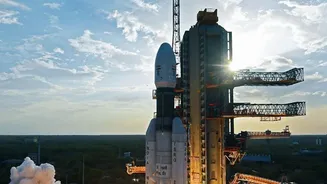
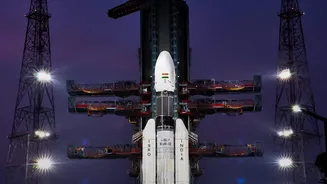
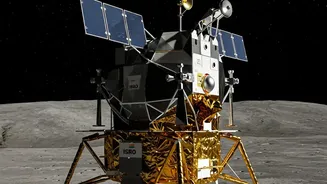
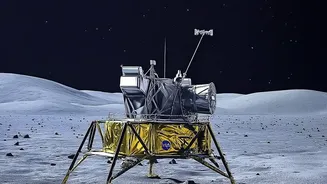
Chandrayaan-4 is so massive and complex that it cannot be launched by a single rocket. Instead, ISRO has devised an innovative dual-launch strategy using two of its powerful LVM3 rockets. The mission's hardware is divided into five separate modules, which are packed into two launch stacks. The first rocket will carry the Descender Module (the lander) and the Ascender Module. The second rocket will launch the Propulsion Module, Transfer Module, and the all-important Re-entry Module, which will protect the samples during their fiery return through Earth's atmosphere. This approach requires a maneuver that is a first for ISRO on this scale: the two stacks will have to meet and dock in Earth's orbit to form the complete, integrated spacecraft before beginning the journey to the Moon.
The Complex Dance in Lunar Orbit
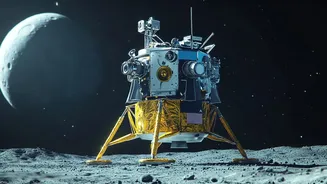
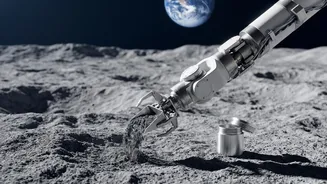
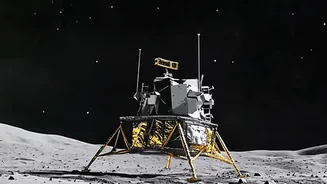
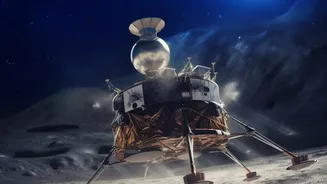
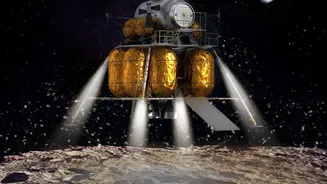
Once the integrated spacecraft reaches lunar orbit, the mission's most intricate phases begin. The lander and ascender stack will separate and perform a soft landing near the Moon's south pole, mirroring the success of Chandrayaan-3. On the surface, a robotic arm and a drilling mechanism will collect both surface and sub-surface samples, which will be sealed in contamination-proof containers within the Ascender Module. With its precious cargo secured, the Ascender will then do something unprecedented for India: it will launch itself off the Moon's surface, using the lander as a launchpad. It will then have to autonomously rendezvous and dock with the Transfer and Re-entry modules, which will have been waiting in lunar orbit. After the sample container is transferred, the ascender is left behind.
The Final Hurdle: Bringing It Home
With the samples safely aboard the Re-entry Module, the Transfer Module will fire its engines to push the capsule out of lunar orbit and onto a trajectory toward Earth. As it approaches our planet, the Re-entry Module will separate for the final, critical stage of its journey. It must survive the intense heat and pressure of re-entering Earth's atmosphere at extreme speeds before deploying parachutes for a safe landing. If successful, India will join an exclusive club of nations—the US, the former Soviet Union, and China—that have successfully brought lunar material back to Earth. Scheduled for around 2028, the mission is not just a scientific endeavor; it's a crucial stepping stone for India’s long-term ambitions, including the goal of a crewed lunar landing by 2040.