





Meet the Nancy Grace Roman Space Telescope
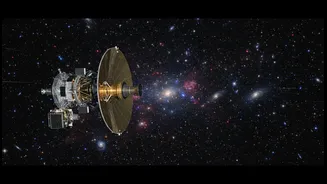
The next great eye in the sky is NASA's Nancy Grace Roman Space Telescope, slated for launch around August 2026. Named after Nancy Grace Roman, NASA's pioneering first chief of astronomy, this observatory is not just another telescope; it's a cosmic survey
machine. While telescopes like the James Webb Space Telescope (JWST) are designed to peer deeply into small patches of the sky for incredible detail, Roman is built for breadth. Its primary mirror is the same size as Hubble's, but its field of view is a staggering 100 times larger. This allows it to create vast, high-resolution panoramas of the universe, making it perfectly suited for a grand statistical search for new planets.
A New Way of Detecting Worlds
Roman will be a master of a technique called gravitational microlensing. This method, predicted by Albert Einstein's Theory of General Relativity, relies on a cosmic coincidence. When a star with a planet passes in front of a more distant star from our perspective, its gravity acts like a lens, bending and magnifying the background star's light. If the foreground star has a planet, that planet's own smaller gravity will cause a brief, secondary spike in the brightness. This tiny planetary signal is the key. Unlike other methods that are best at finding large planets orbiting very close to their stars, microlensing is uniquely sensitive to planets with larger orbits, similar to Jupiter or even Earth, and at great distances from us.
The Challenge of Crowded Skies
To maximize the chances of catching these rare microlensing events, Roman will stare intently at the most crowded part of our galaxy: the dense star fields toward the center of the Milky Way. The sheer number of stars in its view—hundreds of millions at a time—is what makes the mission so powerful. While the odds of any single star aligning perfectly are incredibly low, by monitoring so many stars simultaneously, Roman is expected to detect thousands of these events. This strategy allows it to build a massive census of planetary systems, helping scientists understand how common planets are across the galaxy, from gas giants to smaller, rocky worlds.
A Powerful Partner for Webb
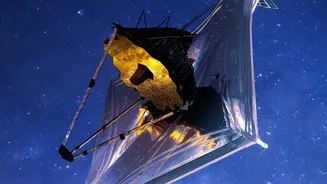
Roman and the James Webb Space Telescope are designed to be complementary partners in cosmic discovery. Both will orbit at the same stable point a million miles from Earth, known as the second Lagrange Point (L2). Roman will act as the wide-angle scout, identifying thousands of new planets and other fascinating cosmic objects. Webb can then perform detailed follow-up observations, using its powerful spectrographs to analyze the atmospheres of the most interesting worlds Roman finds. While Roman finds the needles in the haystack, Webb can study them under a microscope. Together, they will provide a more complete picture of the cosmos, from its grand structure to the details of individual alien worlds.