

Capturing a Fleeting Moment
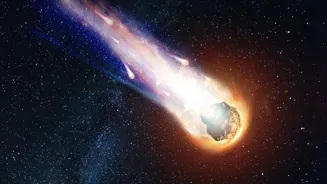
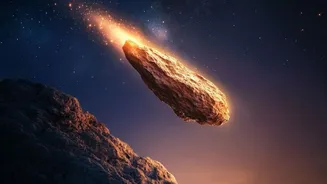
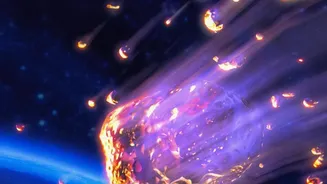
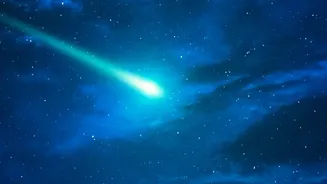
Before scientists can analyze an orbit, they first have to record it. A meteor, or shooting star, is the visible streak of light that occurs when a space rock called a meteoroid enters Earth's atmosphere at high speed. These events are incredibly brief,
often lasting just a few seconds. To catch them, networks of specialized cameras are positioned around the globe, from the Australian outback to the American Midwest. Networks like NASA's All Sky Fireball Network and the Desert Fireball Network use multiple cameras to automatically film the sky. When a bright meteor, known as a fireball, appears, several cameras can record it from different angles. Using triangulation—the same geometric principle used in surveying—researchers can precisely calculate the meteor's trajectory, speed, and altitude as it burns up. This provides the raw data needed to reconstruct its path back into space.
The Blueprint of an Orbit
Once the trajectory through our atmosphere is known, scientists can calculate the meteoroid's original orbit around the Sun. This orbit is a cosmic fingerprint, defined by several key elements. The shape of the orbit—whether it's a nearly circular path or a long, stretched-out ellipse—is a major clue. Its inclination, or the tilt of its path relative to the plane of the planets, is another. By analyzing these parameters, astronomers can determine how far from the Sun the object travelled (its aphelion) and how close it got (its perihelion). Working backwards from its entry into our atmosphere, they can effectively trace its steps, pinpointing the neighbourhood in the solar system it once called home.
A Chip Off the Old Asteroid Block
Many meteors follow orbits that lead directly back to the asteroid belt, the sprawling ring of rocky bodies located between Mars and Jupiter. These meteoroids are fragments knocked loose from larger asteroids by ancient collisions. Their orbits are typically quite stable and look similar to those of the planets—more circular and not highly inclined. Scientists can often match a meteoroid's composition and orbital data to specific 'families' of asteroids that were created from a single parent body breaking apart. In fact, recent studies suggest that the vast majority of meteorites that survive the fall to Earth and are later recovered come from just a few major collisions in the asteroid belt.
The Ghostly Trail of Comets
Have you ever watched a meteor shower, like the Perseids in August or the Leonids in November? These spectacular events have a very different origin. They occur when Earth passes through the stream of dust and debris left behind by a comet. Comets are often described as 'dirty snowballs' made of ice, dust, and rock. As a comet gets close to the Sun, its ice vaporizes, releasing a trail of tiny particles. This debris continues to travel along the comet's original, often highly elliptical and inclined, orbit. When our planet intersects this stream, we experience a meteor shower. The parallel paths of the particles entering our atmosphere create the illusion of radiating from a single point in the sky, known as the radiant. The orbit tells the story: if a meteor's path matches the known orbit of a comet, its parentage is clear.
Visitors from Beyond
The most tantalizing possibility is that a meteor came from outside our solar system entirely. An object from interstellar space would travel so fast that the Sun's gravity couldn't capture it into a closed loop. Instead of an ellipse, its path would be a 'hyperbolic' orbit—an open-ended curve. Identifying these interstellar visitors is challenging because the difference between a very fast object from our own solar system and a true interstellar one can be minuscule, and measurement errors can create ambiguity. However, a high-velocity hyperbolic orbit is the key smoking gun. While confirmed examples are rare and sometimes debated, such as the 2014 fireball CNEOS 2014-01-08, each potential candidate offers an extraordinary chance to study material from another star system without ever leaving home.