







The Universe's Most Precise Clocks
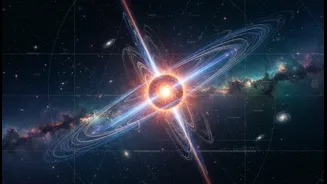
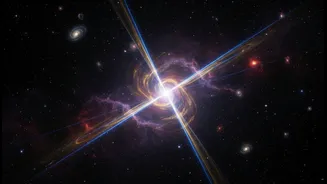
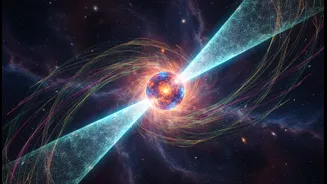
Imagine a star more massive than our sun, crushed into a city-sized sphere, spinning hundreds of times every second. That’s a neutron star. A pulsar is a special kind of neutron star that shoots out powerful beams of radiation from its magnetic poles.
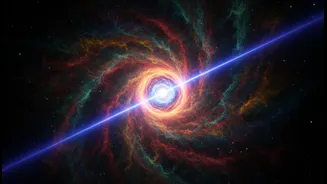
As it spins, these beams sweep across space like a lighthouse. From Earth, we detect these beams as incredibly regular pulses of energy. This regularity makes them the most stable and precise clocks known in the universe. It's this precision that scientists are harnessing. Any tiny deviation in the arrival time of a pulse can signal that something—like a gravitational wave or interstellar gas—has affected its long journey to Earth.
Building the Galactic Map
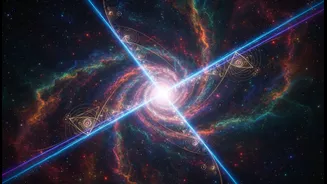
There isn't a single project called the 'Lighthouse Pulsar Map'. Rather, it's a descriptive term for the ongoing work of multiple observatories and missions, most notably NASA's Neutron star Interior Composition Explorer (NICER). Installed on the International Space Station, NICER is an X-ray telescope that precisely measures the arrival times of X-ray photons from pulsars. This data helps scientists create detailed maps of pulsars, their surface features, and their environments. Collaborations like the North American Nanohertz Observatory for Gravitational Waves (NANOGrav) and the Indian Pulsar Timing Array (InPTA) use networks of radio telescopes to monitor an array of pulsars, creating a galaxy-sized detector for cosmic events.
A Natural Laboratory for Extreme Physics
So, why go to all this trouble? Because pulsars are natural laboratories for physics that we could never replicate on Earth. The matter inside a neutron star is the densest in the observable universe, squeezed by immense gravity. By measuring a pulsar's mass and size—something NICER has done with unprecedented accuracy—scientists can finally test theories about how matter behaves under these extreme conditions. Furthermore, the mind-bogglingly strong magnetic fields of pulsars act as powerful particle accelerators. They rip particles from the star's surface and fling them into space at nearly the speed of light, creating high-energy cosmic rays. Studying the radiation from these events helps scientists understand one of the great mysteries of astrophysics: where the universe's most energetic particles come from.
Detecting the Hum of the Universe
One of the most profound applications of pulsar mapping is the detection of gravitational waves. While detectors like LIGO find high-frequency waves from colliding black holes or neutron stars, pulsar timing arrays are designed to sense something much larger: a low-frequency background hum of gravitational waves that fills the universe. This hum is thought to be generated by pairs of supermassive black holes slowly orbiting each other at the centers of merging galaxies. By monitoring dozens of pulsars across the sky, scientists look for a specific correlated pattern in their pulse arrival times—a sign that spacetime itself is being gently stretched and squeezed by these faint, ancient waves. Recent evidence from pulsar timing arrays suggests we have finally heard the first notes of this cosmic symphony.
A Grounded Perspective
Now for the reality check promised in the headline. Will this research unlock all the secrets of the cosmos overnight? Of course not. Science is a slow, methodical process. Mapping pulsars is less about a single 'eureka' moment and more about building a solid foundation of data. For instance, using pulsars for autonomous spacecraft navigation (a concept called SEXTANT) has been successfully demonstrated but remains a developing technology. The true value of the 'lighthouse map' is its power as a tool. It provides a new and independent way to probe the universe, confirming some theories, challenging others, and providing hard data where only theories existed before. For example, NICER's maps of pulsar hot spots have already challenged textbook models, showing them to be far more complex and strangely shaped than previously imagined.