






The Observer Effect of Breathing
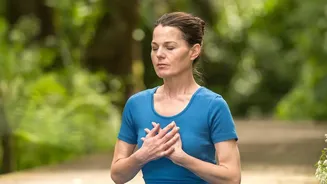
The moment you decide to watch your breath, your brain switches from autopilot to manual control. This is a normal, almost universal experience for beginners. Our bodies breathe all day without any conscious instruction, but the second we direct our focus,
we often feel an urge to 'do it right'. This self-consciousness can lead to feeling like you are suddenly interfering, making the breath feel short, constricted, or unnatural. The problem isn't that you're bad at this; it's that your attentive brain wants to help by taking charge. The first step is to recognise this is happening and understand that it is a natural part of the learning process.
Shift Your Goal from Control to Curiosity
The purpose of breath awareness is not to achieve a 'perfect' breath, but simply to notice what is already there. There is no ideal breath; it can be deep or shallow, fast or slow, and all are perfectly fine. The practice is about being with your breath exactly as it is in that moment. Try to adopt an attitude of gentle curiosity. Instead of thinking, 'Am I doing this correctly?', ask, 'What does this breath feel like?' This mental shift moves you from the role of a 'breather' who must perform, to a passive observer watching a natural phenomenon. Trust that your body knows exactly how to breathe.
Find a Gentle Anchor for Your Attention
To stop yourself from taking over the breathing process, give your mind a more specific, passive job. Instead of focusing on the broad idea of 'the breath', anchor your awareness to a single, subtle sensation. You might focus on the feeling of cool air entering your nostrils on the inhale and warm air leaving on the exhale. Or, you could place a hand on your stomach and simply notice the gentle rise and fall, without trying to make it bigger or smaller. This gives your mind a 'home base' to return to, a concrete sensory detail that is harder to manipulate than the breath itself.
What to Do When You Start Forcing It
You will inevitably find yourself controlling your breath again. This is not a failure. The practice is not about perfectly uninterrupted observation; it's about noticing when your mind has wandered or taken control, and gently returning. When you realise you're forcing it, don't get frustrated. Simply acknowledge it with a mental note like, 'controlling' or 'thinking'. Then, you can use a simple reset: take one slightly deeper, more intentional sigh or exhale. This can act as a circuit breaker. After that, let go and allow the next breath to happen all on its own, returning your focus to your anchor.
Practice in 'Micro-Doses' Throughout the Day
You don't need a 30-minute meditation session to build this skill. In fact, starting small can be more effective. Look for spare moments in your day—waiting for your tea to brew, sitting at a red light, or waiting for a file to download. In these moments, simply try to observe one or two natural breaths. Feel your feet on the floor, notice your posture, and tune into the sensation of that single inhale and exhale without any pressure to do it for a long time. These 'micro-doses' of awareness build the mental muscle of observation in low-stakes situations, making it easier to access when you do decide to practice for longer periods.