








The Loneliest Alarm Clock
On July 7, 2026, after 321 days of silent sleep, NASA's New Horizons spacecraft successfully powered up its main systems. The confirmation signal, travelling at the speed of light, took nearly nine hours to cross the vast distance from the outer Kuiper
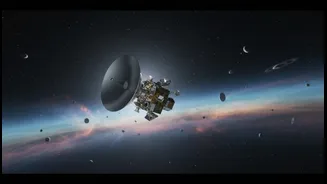
Belt to a tracking station in Spain. For the engineers at the Johns Hopkins Applied Physics Laboratory (APL), it was a moment of triumph. New Horizons, launched in 2006, famously flew past Pluto in 2015 and later the Kuiper Belt Object Arrokoth. Now, it serves as a distant outpost, proving our ability to build machines that can endure and function at the edge of the solar system. Its successful awakening from its longest-ever hibernation is a testament to the incredible foresight and design that went into it.
The Enemy: Deep Space
Deep space is an unforgiving environment for any machine. The primary threats are the extreme cold and radiation. Without the Sun's warmth, temperatures can plunge to levels that make materials brittle and electronics fail. Furthermore, space is filled with high-energy particles from solar wind and cosmic rays that can disrupt or destroy sensitive electronics, causing 'bit flips' where a 0 becomes a 1 in computer memory, potentially leading to catastrophic errors. Unlike on Earth, where our atmosphere and magnetic field provide protection, spacecraft are completely exposed. Power is also a finite resource; far from the sun, solar panels are useless, so probes like New Horizons rely on the steady but diminishing heat from a radioisotope thermoelectric generator (RTG).
The Art of Hibernation
To survive the long, quiet cruise between encounters, mission planners devised a strategy of hibernation. This involves powering down most of the spacecraft's systems, including science instruments, transmitters, and flight computers, to conserve power and reduce wear and tear. New Horizons entered a slow, stable spin while its primary computer kept a quiet vigil. During this deep sleep, it sent a simple weekly 'beacon' tone back to Earth. A 'green' tone meant all was well, while a 'red' tone would have signaled a problem requiring intervention from the ground team. Even while hibernating, a few key instruments continued to collect data around the clock on the surrounding plasma and dust environment, making the journey itself a scientific endeavour.
Building a Survivor
Hibernation alone isn't enough. The spacecraft itself is an engineering marvel of thermal management. The sensitive electronics are housed within the core of the probe, insulated by multi-layer blankets that look like gold or silver foil. This Multi-Layer Insulation (MLI) is incredibly effective at both retaining the internal heat generated by the electronics and the RTG, and reflecting the intense cold of deep space. The components themselves are also 'radiation-hardened', specially designed and shielded to resist damage from energetic particles. This focus on reliability over raw performance is why spacecraft often use processors that seem dated by earthly standards; in the void of space, survival is infinitely more important than speed.
Lessons for the Future
The successful revival of New Horizons is more than just good news for one mission; it validates the entire strategy for long-duration deep space exploration. Every time the spacecraft wakes up perfectly, it gives engineers more confidence in the designs and materials used. This knowledge is critical for planning even more ambitious future missions, such as probes to the ice giants Uranus and Neptune, or even interstellar probes that would travel for decades or centuries. The awakening confirms that we can build robotic explorers capable of surviving years of inactivity in a frozen, radioactive environment and then function perfectly when called upon. It shows that our reach into the cosmos is limited less by the environment and more by our ingenuity.