



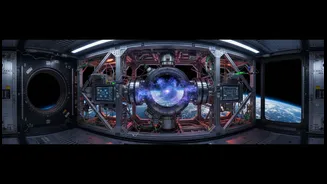


Creating a Fifth State of Matter
At the heart of this research is a bizarre and fascinating state of matter first predicted by Albert Einstein and Satyendra Nath Bose a century ago. When you cool atoms to temperatures just a sliver above absolute zero (minus 273.15 degrees Celsius),
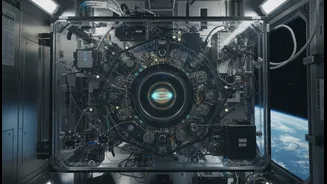
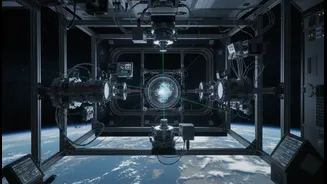
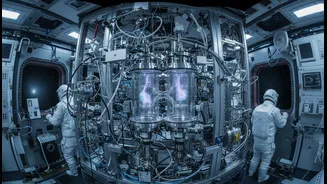
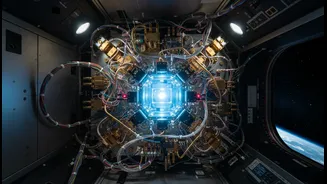
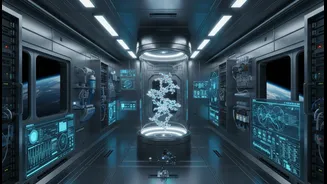
they stop behaving like individual particles and start acting like a single, collective wave. This fifth state of matter, known as a Bose-Einstein Condensate (BEC), allows scientists to observe strange quantum phenomena on a scale large enough to see. On Earth, creating a BEC is an immense challenge. In space, it becomes a revolutionary tool. To get there, NASA’s Cold Atom Laboratory (CAL) uses a sophisticated combination of lasers and magnetic fields inside a vacuum chamber. Lasers are fired at a cloud of atoms, like rubidium or potassium, slowing them down and dramatically dropping their temperature.
The Microgravity Advantage
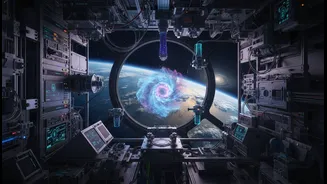
So why go through the trouble of sending a high-tech refrigerator into orbit? The answer is gravity. Here on Earth, gravity relentlessly pulls on the delicate, ultra-cold atom clouds, causing them to collapse in a fraction of a second. This gives researchers a fleeting moment to study them. In the microgravity environment of the International Space Station, however, these quantum waves can be observed for much longer periods—up to ten seconds or more. This extended observation time is a game-changer, allowing for more precise measurements and revealing subtle effects that are invisible on the ground. The near-weightless conditions also allow the atoms to cool even further than in terrestrial labs, as the magnetic trap used to hold them can be made much weaker, letting the atom cloud expand and cool itself down.
A New Chapter of Discovery
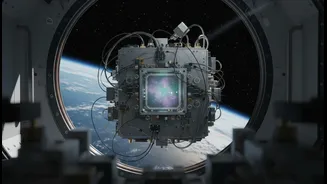
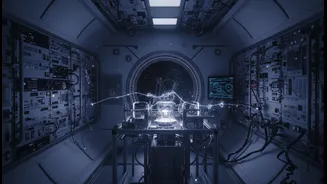
The Cold Atom Lab has been operating since 2018, but a recent upgrade in the spring of 2026 has officially kicked off a new, more powerful phase of research. Astronauts aboard the ISS installed new hardware, including a redesigned magnetic trap. This crucial component gives scientists unprecedented control to shape the BECs, allowing them to explore the quantum gas clouds in new ways. The upgrade, the fourth major enhancement for the facility, also included improved atom sources and more sensitive measurement capabilities. These improvements mean researchers can now create larger, more complex quantum states than ever before, pushing the boundaries of what we can learn from the coldest matter in the cosmos.
From Quantum Waves to Future Tech
While studying the fundamental laws of the universe is a primary goal, the work being done on the CAL is also paving the way for what some call 'Quantum 2.0'. The first quantum revolution gave us transistors and lasers by passively using quantum effects. This new era is about actively manipulating quantum states to build revolutionary technologies. The extreme sensitivity of BECs makes them ideal for a new generation of ultra-precise quantum sensors. By observing how these matter waves interact with their environment, scientists could develop devices capable of mapping Earth’s gravity field with enough precision to detect underground water reserves or magma moving deep beneath a volcano. This research is also foundational for developing better navigation and timing systems, crucial for future deep space exploration missions to the Moon and beyond.