



A Water World Far From Home
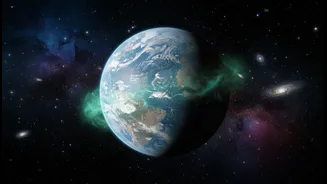
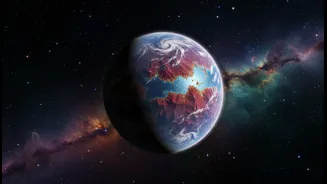
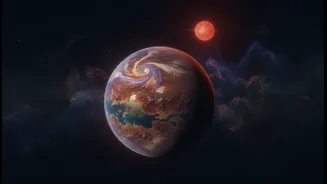
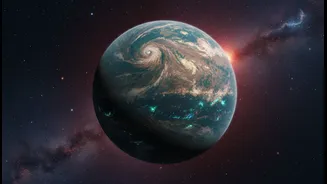
Located 124 light-years away in the constellation Leo, K2-18b is what’s known as a sub-Neptune exoplanet. It’s about 8.6 times the mass of Earth and 2.6 times larger. What makes it particularly special is that it orbits within its star's habitable zone,
the region where temperatures are just right for liquid water to exist. Previous observations had already detected carbon-based molecules like methane and carbon dioxide, and the lack of ammonia in its atmosphere strongly suggested the presence of a vast liquid water ocean beneath a hydrogen-rich atmosphere. This led scientists to classify it as a potential 'Hycean' world—a portmanteau of 'hydrogen' and 'ocean'—a new and exciting category of potentially habitable planets.
A Whiff of Something Special
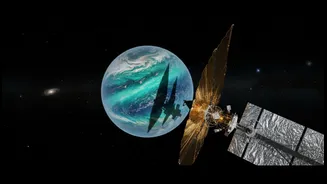
During recent observations, the James Webb Space Telescope (JWST) detected something that made astronomers sit up and take notice: the possible presence of dimethyl sulfide (DMS). This is a profound finding because, on our planet, DMS is produced almost exclusively by life, primarily by microscopic marine organisms like phytoplankton. The detection of DMS on a world that is already a prime candidate for hosting a liquid ocean is one of the most intriguing hints of potential biological activity found to date beyond our solar system. The initial signal, first hinted at in 2023 and followed up with more data, represents one of the most significant biosignature candidates ever identified.
Managing Expectations: Caution Before Celebration
While the news is incredibly exciting, scientists are urging caution. The detection of DMS is still tentative and has not yet reached the 'five-sigma' level of statistical confidence required to declare a definitive discovery. The initial announcement reported a 'three-sigma' confidence, which means there is a 99.7% chance the signal is real, but that still leaves a small probability that it could be a random fluke or instrumental noise. Furthermore, some researchers have questioned the analysis, suggesting other atmospheric gases could be interfering with the measurement. Science is a process of verification, and this extraordinary claim requires extraordinary evidence. More observation time with the JWST is needed to confirm the signal is truly DMS and not something else.
Could It Be Something Else?
Even if the gas is confirmed to be dimethyl sulfide, it does not automatically mean there is life on K2-18b. Scientists must first rule out any non-biological, or 'abiotic', ways the gas could be produced. While DMS on Earth is linked to life, the chemistry of a Hycean world with a hydrogen-rich atmosphere is very different. Some recent modeling suggests that unknown photochemical reactions, driven by light from the planet's star, could potentially create DMS without any living organisms involved. The concentration of the detected gas also appears to be thousands of times stronger than on Earth, which could either point to a world teeming with life or a completely novel geological or chemical process not seen in our solar system.
The Next Chapter in the Search for Life
Regardless of the final outcome, the findings from K2-18b are a landmark achievement for the James Webb Space Telescope and for the field of astrobiology. The ability to detect trace gases in the atmosphere of a planet more than a quadrillion kilometres away is a technological marvel. Researchers have already applied for more observation time to stare at K2-18b, hoping to strengthen the signal and rule out other possibilities. Whether K2-18b turns out to host life or reveals new, unexpected planetary chemistry, it has already pushed the boundaries of exploration. It marks a pivotal moment, shifting the search for extraterrestrial life from a theoretical exercise to a tangible, data-driven quest.