




What is a Coronal Mass Ejection?
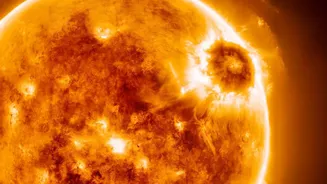
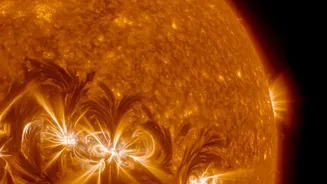
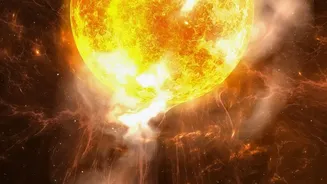
A Coronal Mass Ejection, or CME, is a massive expulsion of plasma and magnetic field from the Sun's outer atmosphere, the corona. Think of it as a giant, explosive solar burp. These events happen when twisted magnetic field structures in the Sun's lower
corona become overly stressed and suddenly reconfigure, releasing immense energy. This process can fling billions of tonnes of solar material into space at incredible speeds, ranging from a relatively slow 250 kilometres per second to an astonishing 3,000 km/s. The fastest of these eruptions can reach Earth in as little as 15 to 18 hours, creating what we call space weather.
The Danger to Our Satellites
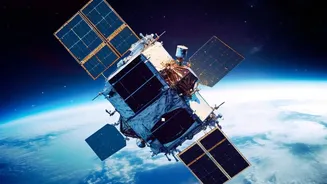
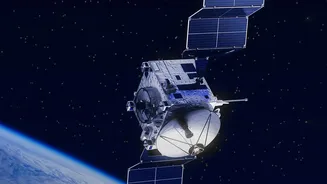
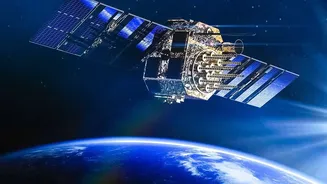
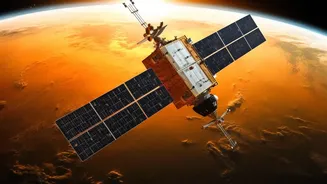
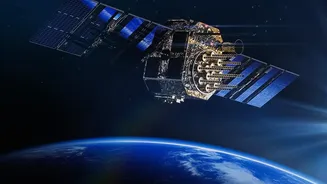
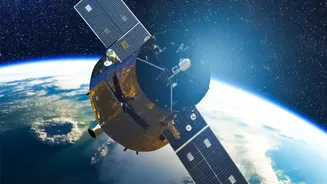
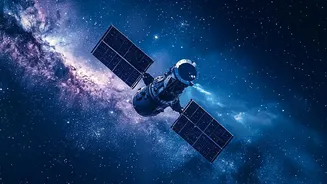
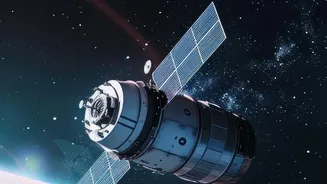
Our modern world runs on satellites. They are crucial for navigation, financial transactions, communication, and weather forecasting. However, these orbital assets are extremely vulnerable to space weather. When a CME hits Earth's magnetic field, it can trigger a geomagnetic storm. This storm is a deluge of energetic particles, primarily protons and electrons, that can wreak havoc on satellite systems. These particles can penetrate and damage sensitive electronics, degrade solar panels that power the satellites, and disrupt radio signals. In severe cases, the increased atmospheric drag caused by a storm can even cause satellites in low-Earth orbit to lose altitude and re-enter the atmosphere prematurely. A stark example of this occurred in February 2022, when a moderate geomagnetic storm destroyed up to 40 newly launched Starlink satellites.
Building a Virtual Sun
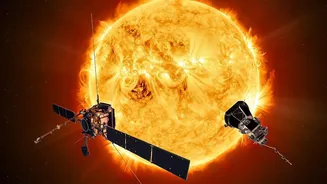
To predict a CME's threat, scientists can't just look at the Sun and guess. They build sophisticated computer simulations. This process starts with data. Spacecraft like NASA's Solar and Heliospheric Observatory (SOHO) and the Solar Terrestrial Relations Observatory (STEREO) constantly monitor the Sun. They gather crucial information about the Sun’s magnetic field, plasma density, and temperature. This data serves as the essential input, the starting conditions, for complex numerical models. By feeding real-time observations into these models, scientists can create a virtual, evolving picture of the Sun's corona.
The Physics of the Simulation
At the heart of these simulations is a field of physics called magnetohydrodynamics, or MHD. In simple terms, MHD describes the behaviour of electrically conducting fluids, like the plasma that makes up a CME. The models use a set of complex equations to calculate how this plasma and its embedded magnetic field will erupt and travel through space. These simulations, such as the widely used ENLIL model, can forecast a CME's trajectory, its speed, and the strength and orientation of its magnetic field. This is crucial because a CME's magnetic field orientation determines how severely it will interact with Earth's own magnetic field.
From Simulation to Actionable Warning
The output of these simulations is not just an academic exercise; it's a vital early warning system. Forecasters at agencies like NOAA's Space Weather Prediction Center use these models to predict the arrival time and intensity of a potential geomagnetic storm. This gives satellite operators precious hours or even days of lead time. With this warning, they can take protective measures, such as temporarily shutting down non-essential systems, reorienting the spacecraft to protect sensitive components, or in some cases, slightly adjusting its orbit to mitigate atmospheric drag. It’s a high-stakes race against a wave of solar radiation, and these simulations are the key to getting a head start.