



Earth's Familiar Rhythm
Before we dive into the strangeness of Venus, let’s quickly recap how things work on Earth. We have two main types of 'day'. An axial day (also called a sidereal day) is the time it takes for the planet to complete one full 360-degree rotation on its
axis. For Earth, that’s about 23 hours and 56 minutes. A solar day is the time it takes for the sun to appear in the same position in the sky again—what we think of as 24 hours. The small difference is due to Earth also moving along its orbit around the sun. And, of course, a year is the time it takes to complete one full orbit: roughly 365 days. This rhythm is simple, predictable, and the foundation of our lives.
Venus Throws Out the Rulebook
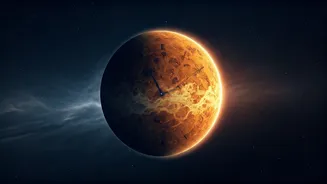
Now, let’s go to Venus, often called Earth’s “twin” because of its similar size and mass. That’s where the similarities end. Venus has the slowest rotation of any planet in our solar system. An axial day on Venus—one full spin on its axis—takes approximately 243 Earth days. Here’s the mind-bending part: a Venusian year—the time it takes to orbit the sun—is only about 225 Earth days. This means that a single rotation of the planet takes longer than its entire journey around the sun. If you could stand on Venus, you would celebrate your first 'birthday' (one orbit) before you had even experienced a full 'day' (one rotation).
The Retrograde Twist
To make things even more confusing, Venus spins backwards. Unlike Earth and most other planets in our solar system, which spin counter-clockwise, Venus has a retrograde (clockwise) rotation. This has a dramatic effect on its solar day. Because the planet is spinning in the opposite direction to its orbit, the time between one sunrise and the next is significantly shorter than its rotation period. A solar day on Venus is about 117 Earth days long. So, while a full rotation takes 243 days, you would only have to wait 117 days for the sun to return to the same spot in the sky. And because of this backward spin, the sun on Venus rises in the west and sets in the east.
Why is Venus So Weird?
Scientists are still debating the exact cause of Venus's slow, backward spin. One leading theory suggests that Venus was struck by a massive asteroid or other celestial body early in its history, which either dramatically slowed its rotation and flipped it upside down or sent it spinning in the opposite direction. Another compelling hypothesis involves its incredibly thick atmosphere. Some models suggest that the dense, heavy atmosphere—90 times thicker than Earth’s—could have created powerful atmospheric tides. Over billions of years, the friction between the planet and its super-rotating atmosphere could have slowed its spin to the crawl we see today. It’s possible both factors played a role.
A Truly Hellish World
This bizarre rotation is just one feature of a truly extreme environment. The thick atmosphere is composed almost entirely of carbon dioxide, creating a runaway greenhouse effect that makes Venus the hottest planet in the solar system. Surface temperatures average a scorching 465°C, hot enough to melt lead. The atmospheric pressure on the surface is equivalent to being 900 metres deep in Earth's oceans—enough to crush a submarine. To top it off, the sky is filled with clouds of sulphuric acid. This hellish landscape is a stark reminder that even a planet so similar to Earth in size can follow a vastly different evolutionary path.