



Beyond the Cosmic Portraits
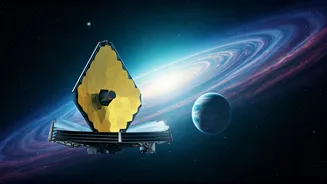
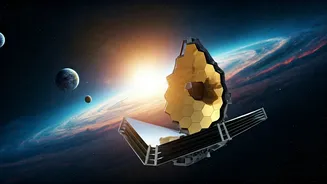
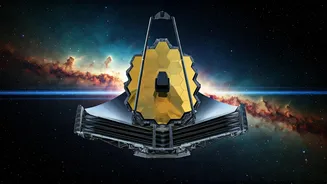
Since its launch, the James Webb Space Telescope (JWST) has captivated the world with breathtaking images of distant cosmic structures. These images are more than just pretty pictures; they are scientific data, revealing secrets about the birth of stars
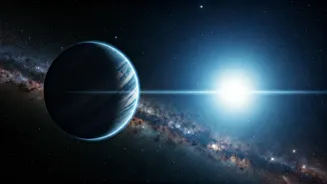
and the assembly of galaxies. Yet, a quieter, arguably more revolutionary, aspect of Webb's mission is often overlooked. A significant portion of its observation time, around 25% in its first year alone, is dedicated to studying exoplanets—worlds orbiting stars other than our Sun. This work doesn't always produce spectacular visuals. Instead, it generates squiggly lines on a graph, data known as spectra. And within these lines lies the information that could fundamentally alter our place in the universe, moving us closer to answering one of humanity’s oldest questions: Are we alone?
Decoding Alien Atmospheres
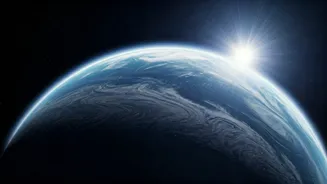
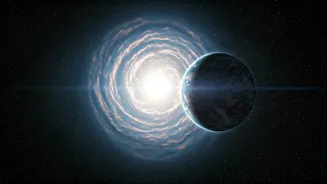
Webb's primary tool for exoplanet study is spectroscopy. When an exoplanet passes in front of its star from our perspective, a tiny fraction of the starlight filters through the planet's atmosphere. Webb's sensitive instruments can capture this light and spread it into a spectrum. Different molecules in the atmosphere absorb light at specific wavelengths, leaving dark lines—like a chemical barcode—in the spectrum. By reading this barcode, astronomers can identify the gases present, such as water vapor, methane, and carbon dioxide. This technique has already yielded remarkable findings. Webb has provided clear evidence of water in the atmosphere of a gas giant and detected carbon dioxide and sulfur dioxide for the first time on another world, providing evidence of chemical reactions driven by starlight. This isn't just a cataloging exercise; it's the first step in understanding the climate and conditions of these alien worlds.
The Rocky Road to Finding Another Earth
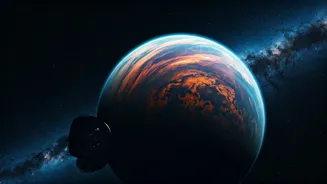
The ultimate prize is analyzing the atmosphere of a rocky, Earth-sized planet in its star’s habitable zone—the region where temperatures could allow for liquid water. This is an incredibly challenging task. These planets are small, and their potential atmospheres are thin. The famous TRAPPIST-1 system, with its seven rocky worlds, has been a prime target. So far, Webb's observations suggest the innermost planets, TRAPPIST-1b and 1c, are likely airless rocks, scorched by their star. This is not a failure, but a crucial data point, showing how harsh the environment around red dwarf stars can be. Other studies have produced tantalizing hints of water vapor around rocky worlds, but scientists are cautious, working to rule out contamination from the star itself. Each observation, whether it finds an atmosphere or not, refines our models of how planets form and evolve.
Why This Science Deserves the Spotlight
The search for life is a slow, methodical process. Unlike a stunning photo of a nebula, the discovery of a potentially habitable world will not happen in a single press release. It will be built upon years of painstaking observation, debate, and verification. Recent results published on July 1, 2026, show Webb studying how a Jupiter-sized planet survived the death of its star, finding methane in its atmosphere—a first for a planet orbiting a dead star and a glimpse into our own solar system's distant future. This is the kind of groundbreaking work that can get lost in the daily news cycle. While the beautiful images inspire wonder, it is the patient analysis of exoplanet atmospheres that represents a true paradigm shift. We are living in the era when, for the first time, we are moving from simply detecting points of light to characterizing entire worlds. We are taking a census of our galactic neighbors, trying to understand which are barren, which are gassy, and which, just maybe, look a little bit like home.