

A Cosmic Case of Mistaken Identity
First, let's clear up the big misconception. The comet-like objects in the Helix Nebula aren't comets at all. They are gigantic knots of gas and dust, fittingly called "cometary knots" simply because of their appearance. Discovered in detail by the Hubble
Space Telescope, there are an estimated 40,000 of these structures scattered throughout the nebula. Their scale is immense; the "head" of a single knot can be twice the size of our entire solar system, with a tail stretching 100 billion miles. These are not small, icy rocks but colossal clouds of molecular gas that are part of the nebula itself. Their comet-like shape is a clue not to what they are, but to the violent processes happening around them.
The Head and the Tail
To understand the illusion, you have to look at the structure. Each knot consists of two main parts: a dense, clumpy head and a long, streaming tail, just like a real comet. The heads are incredibly dense—at least 1,000 times denser than the surrounding gas in the nebula. This core is a globule of cool, molecular hydrogen and dust. Because they are so dense, they absorb and block light from behind, sometimes appearing as dark spots against the nebula's brighter background. The tails, which always point radially away from the center of the nebula, are made of the less-dense gas that streams away from the head. This perfect alignment is the key to figuring out the powerful force that’s shaping them.
Forged by Stellar Fire and Shadow
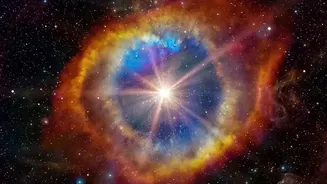
The architect of this cosmic spectacle is the star at the heart of the Helix Nebula. It's a white dwarf, the superheated remnant core of a star that was once like our Sun. This star blasts out intense ultraviolet radiation in all directions. This radiation acts like a powerful wind, a process called "photoevaporation," which ionizes and pushes away the lower-density gas of the nebula. However, the dense, dusty heads of the cometary knots are resilient. They act like giant umbrellas, shielding the gas directly behind them from the stellar radiation. While the exposed gas all around is stripped away, the protected gas behind the knot is drawn out into a long, shadowy tail. It's the same principle that creates a shadow on the ground when you block the sun, but on a cosmic scale, with radiation instead of light and gas instead of a shadow. The glowing, crescent-shaped front of the knot is the ionized "skin" being lit up by the star, completing the comet-like appearance.
Echoes of a Dying Star
So, where did these massive gas knots come from in the first place? They are relics of the star's not-so-distant past. The Helix Nebula itself is a planetary nebula, the expelled outer layers of the dying star. Astronomers theorize that as the star shed its material over thousands of years, instabilities caused some of the gas to clump together. A later, faster wind of hot gas from the exposed stellar core may have then slammed into this older, cooler, clumpy material, fragmenting it further into the droplets we see today. In this sense, the cometary knots are fossils. They are time capsules containing the material from an earlier phase of the star's death. By studying their composition and structure, as the James Webb Space Telescope continues to do, scientists can piece together the dramatic history of how sun-like stars evolve and return their elements to the cosmos, seeding the next generation of stars and planets.