



In the vast emptiness of space, water is more precious than gold. With no corner store to visit 400 kilometres above Earth, astronauts must rely on ingenious technology to survive. This means yesterday's sweat can become today's coffee.
The Ultimate Closed-Loop System
On Earth, we take
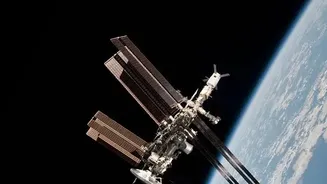
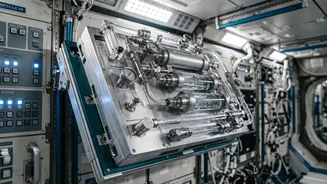
water for granted. On the International Space Station (ISS), it's a matter of survival. Launching supplies into orbit is incredibly expensive, with every kilogram costing thousands of dollars. Ferrying enough water for a crew for months on end is simply not practical. This challenge led to the creation of the Environmental Control and Life Support System, or ECLSS. It's a sophisticated set of hardware designed to regenerate or recycle consumables like air and, most importantly, water. The goal is to create a 'closed-loop' system, where almost nothing goes to waste. Recent advancements have pushed the system's efficiency to an incredible 98% water recovery, a critical milestone for future long-duration missions.
Every Last Drop: The Sources of Wastewater
When engineers say they recycle every drop, they mean it. The Water Recovery System on the ISS collects moisture from every available source. This includes obvious wastewater from hygiene activities like brushing teeth and washing hands. But it also collects moisture that we don't normally think about. Advanced dehumidifiers in the station's atmosphere capture the water vapour from the crew's breath and sweat. And yes, the system also collects and recycles all the crew's urine. Combined, these sources provide the raw material for the station's constant supply of fresh, drinkable water. Even moisture from onboard lab animals can be collected and added to the system.
From Urine to Pure Water: The Purification Process
The process of turning wastewater into something drinkable is a multi-stage marvel of engineering. Urine is the most challenging source, so it goes to a special subsystem first: the Urine Processor Assembly (UPA). The UPA uses a process called vacuum distillation, where a centrifuge helps separate water from the urine brine in microgravity. More recently, a Brine Processor Assembly (BPA) was added to extract even more water from this salty byproduct, using a special membrane and evaporation to capture the last recoverable bits. This reclaimed water, along with all other collected wastewater, is then sent to the Water Processor Assembly (WPA). Here, it goes through a series of specialised filters to remove solids and salts. Then, a high-temperature catalytic reactor breaks down any remaining organic contaminants.
Safer Than Water on Earth
The idea of drinking recycled sweat and urine might sound unappealing, but astronauts and NASA scientists are quick to point out the facts. The resulting water is actually purer than most of the tap water we drink on Earth. After the main filtration and catalytic oxidation steps, the system has one final quality check. Sensors constantly monitor the water's electrical conductivity; because pure water is a poor conductor of electricity, any impurities would register. If the water doesn't meet the stringent purity standards, it's automatically sent back to be reprocessed. Once it passes, a small amount of iodine is added to the water to prevent any microbial growth during storage, ensuring it remains sterile and safe to drink.
Paving the Way for Mars and Beyond
Mastering water recycling isn't just about making life on the ISS sustainable; it's a critical technology for the future of human space exploration. For long-duration missions, like a journey to Mars, resupply missions will be impossible. Astronauts will need a life support system that is almost perfectly efficient and reliable for years at a time. The ECLSS on the ISS serves as a vital testbed for these future systems. The lessons learned and technologies developed also have benefits back on Earth. The advanced filtration and purification concepts pioneered for space have been adapted for use in remote areas or disaster zones where access to clean drinking water is scarce, proving that solving problems for space can help us solve them here at home.