








The New All-Nighter Companion
The pressure on university students has never been higher, and with deadlines approaching, many are seeking an edge to improve their work. This is where Artificial Intelligence tools have stepped in, becoming a ubiquitous part of the academic process.
A 2024 survey found that a staggering 86% of students use AI in their studies. It’s not just about laziness; for many, it's a strategic move. AI can act as a 24/7 tutor, offering instant feedback when professors are unavailable and pressure is mounting. These tools promise to save time, clarify complex topics, and polish a paper to a higher standard, offering a sense of security before the final click of the ‘submit’ button.
More Than Just a Spellcheck
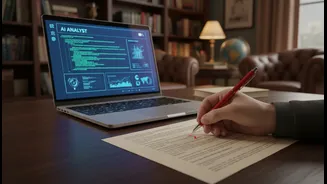
The use of AI in final checks goes far beyond correcting grammar and spelling. Students are employing sophisticated generative AI for a host of tasks that were once the sole domain of human intellect. They use it to brainstorm ideas, summarize dense reading materials, and improve the structure and flow of their arguments. Some advanced tools can even analyze a draft and suggest additional sources or identify hidden patterns in research notes. This represents a fundamental shift from AI as a simple proofreader to AI as an analytical partner. The process can involve significant critical thinking, as crafting effective prompts to get useful feedback is a skill in itself. However, this is also where the ethical lines begin to blur.
The Double-Edged Sword of AI
For all its benefits, relying on AI is fraught with peril. The most significant concern for educators is academic dishonesty. Submitting AI-generated text as one's own is widely considered plagiarism. But the danger isn’t always so clear-cut. AI models can “hallucinate,” fabricating facts and sources that look plausible but are entirely false, making the student accountable for errors they didn't create. Over-reliance can also atrophy critical thinking skills, creating a dependency where the student outsources the intellectual heavy lifting. The technology encourages shortcuts, and while it can feel like a safety net, it can also corrupt the learning process it's meant to support.
A Patchwork of Policies
Indian universities are racing to keep up with the AI boom, but the response has been inconsistent. While over half of higher education institutions report having some form of AI policy, students often face a confusing reality of “policy by professor.” What one instructor encourages as smart use of technology, another may flag as academic misconduct, creating inequity and confusion. There is currently no unified national AI policy for higher education in India. While frameworks like the National Education Policy 2020 encourage AI integration, the lack of clear, standardized guidelines leaves both students and faculty navigating a grey area. Many institutions are now subscribing to AI detection tools, but these are not foolproof and can lead to false accusations, further eroding trust.
Using AI the Smart Way
The consensus among educators is not to ban AI, but to teach its ethical use. The key is to treat AI as an assistant, not a replacement for one's own intellect. Students can be encouraged to use it for brainstorming or getting feedback on structure, but not for generating the core of their work. Transparency is crucial; being honest about when and how AI was used, and citing it if required by the instructor, maintains academic integrity. Ultimately, the student is the one being graded, not the AI. Developing the wisdom to use these powerful tools as a supplement to learning, rather than a substitute for it, is becoming an essential skill for the modern student.