



A New Kind of Atmospheric Brake
For decades, spacecraft have relied on rigid heat shields to survive the fiery plunge through an atmosphere. These shields, like the tiles on the Space Shuttle or the ablative surfaces on Apollo capsules, work well but have a critical limitation: their
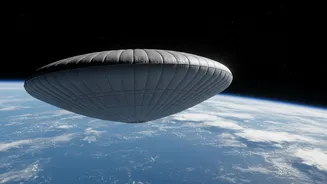
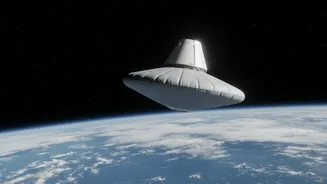
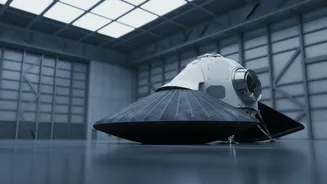
size is constrained by the rocket's protective nose cone, or fairing. This size limit directly caps how much mass can be slowed down, creating a major roadblock for ambitious missions, especially to Mars. Enter the Hypersonic Inflatable Aerodynamic Decelerator, or HIAD. It’s a revolutionary concept that trades rigid metal and ceramic for a structure that can be tightly packed for launch and then inflated in space just before atmospheric entry. This allows for a much larger shield, creating significantly more drag to slow the spacecraft more effectively and at higher altitudes.
Built to Survive a Fiery Plunge
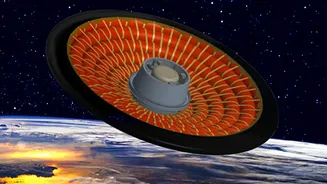
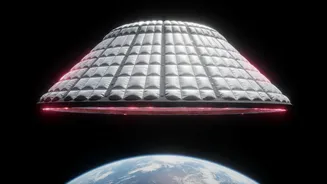
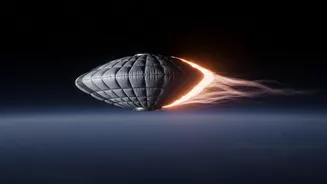
The idea of an inflatable object surviving re-entry temperatures that can reach thousands of degrees might seem counterintuitive. The secret lies in advanced materials science. The outer layer of a HIAD is made from a woven ceramic fabric, often using silicon carbide fibers, that can be spun into a yarn and woven like industrial cloth. Beneath this tough exterior are layers of high-tech flexible insulation. These materials protect the inflatable structure itself, which consists of a series of stacked rings, or tori. These rings are constructed from synthetic polymers that are, pound for pound, many times stronger than steel, allowing them to remain rigid and maintain the shield's shape even under extreme aerodynamic forces. The entire system functions as both a thermal protector and a decelerator, a dual function crucial for mission success.
A Successful Demonstration in Orbit
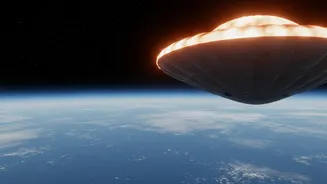
This technology isn't just a theory; it has been proven in the harsh environment of space. The key demonstration was NASA's Low-Earth Orbit Flight Test of an Inflatable Decelerator (LOFTID) mission, which launched in November 2022. LOFTID was a 6-meter (about 20-foot) diameter inflatable aeroshell, the largest blunt body to ever attempt atmospheric entry. After being carried to orbit, the vehicle inflated successfully and re-entered the atmosphere at hypersonic speeds over 18,000 miles per hour. The test was a resounding success. LOFTID survived the extreme heat and forces, slowed down as designed, deployed its parachutes, and splashed down safely in the Pacific Ocean, where it was recovered in excellent condition. The data gathered proved that the HIAD technology is a viable solution for atmospheric entry.
Unlocking the Path to Mars
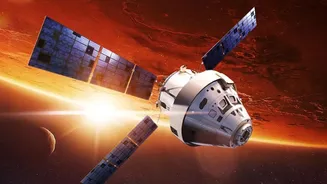
The success of inflatable heat shields is particularly critical for future human missions to Mars. The Martian atmosphere presents a unique challenge: it's thick enough to cause significant heating but too thin to provide enough drag to easily slow down a heavy lander using conventional shields. To land the habitats, ascent vehicles, and supplies needed for a human crew, NASA needs to be able to land payloads far heavier than what was possible with missions like the Curiosity or Perseverance rovers. A larger, inflatable heat shield is an enabling technology for this. By creating more drag higher up in the thin Martian atmosphere, a HIAD can decelerate a heavy spacecraft enough for other systems, like retro-propulsion, to take over for a soft landing. It effectively solves the payload-mass-to-shield-size problem that has long limited Mars mission architecture.
The Future is Flexible and Scalable
With the success of the LOFTID demonstration, the future for inflatable decelerators is bright. The technology is inherently scalable; engineers can design larger shields with more inflatable rings to accommodate even bigger payloads. Beyond Mars, this technology has applications for missions to any celestial body with an atmosphere, such as Venus or Saturn's moon Titan. It also offers a cost-effective way to return large components or even entire rocket stages to Earth for reuse, a key goal for reducing the cost of access to space. Both NASA and European partners are continuing to develop and refine HIAD concepts, viewing them as a cornerstone technology for the next era of ambitious robotic and human exploration across the solar system.