




Meet NASA’s Next Great Observatory
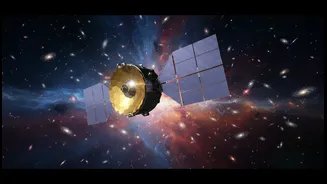
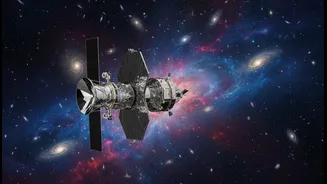
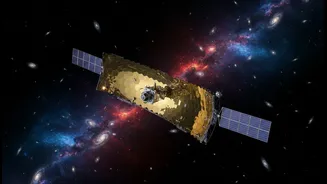
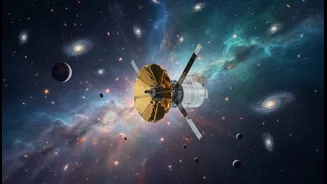
The Nancy Grace Roman Space Telescope, or Roman for short, is NASA's latest flagship astrophysics mission. Named after Nancy Grace Roman, NASA's first chief of astronomy and the “mother” of the Hubble Space Telescope, this new observatory is designed
to tackle some of the biggest mysteries in the universe. With its launch scheduled for August 2026, the telescope has arrived at NASA's Kennedy Space Center in Florida for final preparations. Like the James Webb Space Telescope (JWST), it will orbit the sun a million miles from Earth, a stable vantage point that keeps it cold and provides an unobstructed view of the cosmos. While its 2.4-meter primary mirror is the same size as Hubble's, its mission is fundamentally different, focusing on breadth rather than depth.
A Universe in a Single Glance
The key to understanding Roman is its Wide Field Instrument (WFI). This 300-megapixel infrared camera gives the telescope a field of view at least 100 times larger than Hubble's and Webb's. Imagine looking at the night sky. While Hubble and Webb can zoom in on a single, distant star with incredible detail, Roman can capture an entire constellation, or a patch of sky larger than the full Moon, in a single snapshot. This panoramic capability will allow it to survey the sky up to 1,000 times faster than Hubble. Over its five-year primary mission, Roman is expected to map an area of the sky 50 times larger than Hubble has in over 30 years, creating unprecedented cosmic maps that will serve astronomers for decades.
Tackling the Dark Side of the Cosmos
One of Roman’s primary goals is to investigate the mysteries of dark energy and dark matter. Dark energy is the enigmatic force causing the universe's expansion to accelerate, while dark matter is the unseen material that accounts for the majority of matter in the cosmos. Because Roman can survey billions of galaxies and map their distribution across vast stretches of space, scientists can study how the universe's structure has evolved over time. By measuring the subtle distortion of light from distant galaxies—an effect called weak gravitational lensing—Roman will trace the distribution of dark matter and learn more about the influence of dark energy.
A New Way to Hunt for Planets
Roman is also a powerful planet-hunting machine, expected to discover thousands of new worlds. While it will use the same transit method as the Kepler mission, which watches for the dimming of a star as a planet passes in front, its main technique is gravitational microlensing. This phenomenon, predicted by Einstein, occurs when a star with a planet passes in front of a more distant star. The foreground star’s gravity acts as a natural lens, magnifying the light from the background star. The planet creates its own smaller, tell-tale spike in the light, revealing its presence, mass, and distance from its star. This method is sensitive to planets farther from their stars, similar to those in our own solar system, which are often missed by other techniques. It's predicted that Roman could find around 100,000 planets via the transit method, and thousands more through microlensing.
A Big Picture Partner to Webb
Roman is not a replacement for Hubble or Webb, but a powerful partner. Its ability to quickly scan huge areas of the sky makes it an ideal survey telescope. Roman will act as a cosmic scout, identifying the most interesting targets—be they unusual galaxies, exploding stars, or promising planetary systems. Other telescopes, like the James Webb Space Telescope, can then perform focused, detailed follow-up observations. Webb is designed to peer deep into the early universe with unparalleled sensitivity, while Roman is designed to map the broad cosmic structure. Together, they will provide a more complete understanding of the universe, from the big picture down to the finest details.