



An Accidental Experiment
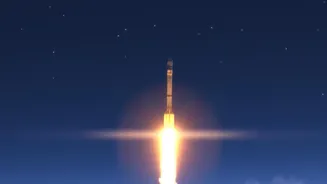
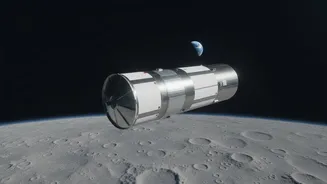
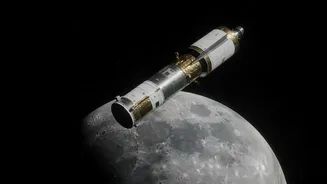
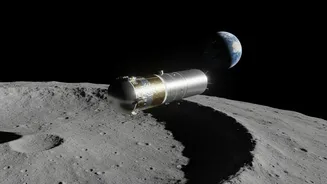
The object in question was the upper stage of a SpaceX Falcon 9 rocket, left adrift in a chaotic orbit after a successful launch in January 2025. The rocket had completed its primary mission: sending two commercial lunar landers on their way to the Moon.
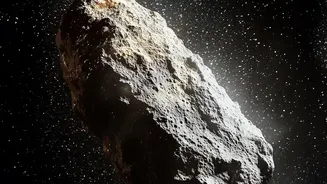
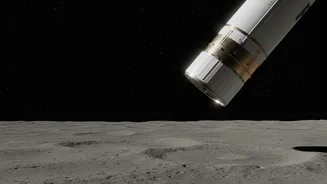
While these upper stages are typically disposed of safely, a combination of solar activity and gravitational forces slowly altered this one's path, putting it on a collision course with the Moon. When astronomers realised the inevitable, they didn’t see it as a problem. They saw it as a gift. Instead of a random piece of space junk, this was an object with a known mass, velocity, and composition, making its impact a perfect, albeit accidental, physics experiment.
Anatomy of an Impact
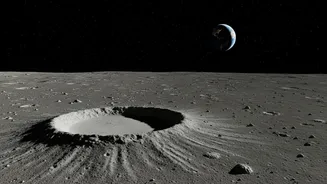
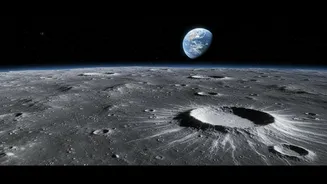
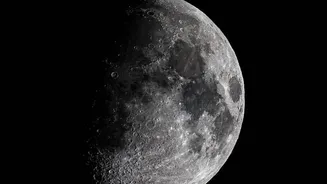
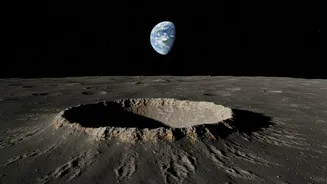
The impact occurred on August 5, 2026, near a feature known as the Einstein Crater, striking the lunar surface at an incredible speed of over 8,700 kilometres per hour. Because the Moon has virtually no atmosphere to burn up incoming objects, the four-ton rocket stage arrived intact. The collision was expected to excavate a brand-new crater between 60 and 100 feet wide, violently kicking up a massive cloud of lunar dust and rock, known as ejecta. While the event itself was not visible from Earth with the naked eye, a global network of scientists had their instruments ready. It was a planned observation of an unplanned event, turning a cosmic coincidence into a coordinated scientific campaign.
Reading the Debris Cloud
The main prize for scientists is analysing that plume of ejecta. By using powerful ground-based telescopes to study the light passing through the dust cloud, researchers can determine its chemical composition. It's like a geological biopsy of the Moon, but from hundreds of thousands of kilometres away. Early observations from the European Southern Observatory's Very Large Telescope in Chile detected sodium, which is likely from the lunar soil, and lithium, which could have come from the rocket's batteries. This technique provides a precious glimpse into the material just beneath the Moon's surface without having to land a probe and drill. Scientists are especially interested in whether such impacts can unearth hidden deposits of water ice, a resource crucial for future lunar bases.
A History of Smashing Success
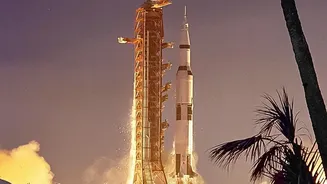
Deliberately crashing things into the Moon for science is a proven technique. During the Apollo era, NASA intentionally slammed the massive third stages of Saturn V rockets into the lunar surface. The resulting tremors were measured by seismometers left behind by astronauts, allowing scientists to map the Moon’s interior structure—in effect, giving the Moon a check-up by making it ring like a bell. More recently, in 2009, NASA's LCROSS mission sent a rocket stage into a permanently shadowed crater near the south pole and flew a second spacecraft through the resulting plume. That mission famously confirmed the presence of water ice, a discovery that has reshaped our plans for returning humans to the Moon.
A Crater for the Future
Beyond the ejecta plume, scientists are eager to study the impact crater itself. Space-based assets like NASA’s Lunar Reconnaissance Orbiter will be tasked with finding and imaging the scar left behind by the Falcon 9 stage. Observing how a crater of this scale forms from a known impactor helps refine computer models that are used to understand the entire history of the Moon, which is defined by billions of years of impacts from asteroids and comets. This accidental crash provides a clean data point that helps researchers better interpret the thousands of natural craters that cover the lunar landscape, adding another small but vital piece to the puzzle of our nearest celestial neighbour.