


What is an AI-Powered VR Classroom?
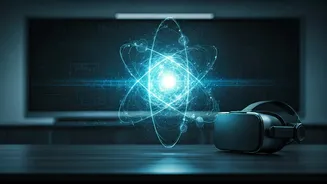
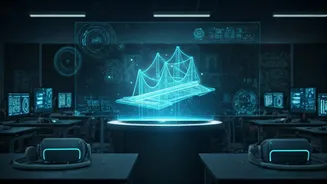
At its core, a Virtual Reality (VR) classroom uses a headset to immerse a student in a completely digital, 3D environment. Instead of reading about planetary orbits, you could stand on Mars and watch Earth rise. But the real game-changer is the addition
of Artificial Intelligence (AI). The AI acts as a super-intelligent, personalised tutor within this virtual world. It can track a student's gaze, understand where they're struggling, and adapt the lesson in real-time. It can answer questions, create new challenges, and provide instant feedback, making the learning experience uniquely tailored to each individual student. It’s the difference between watching a pre-recorded video and having a one-on-one session with a world-class teacher who knows exactly what you need.
Making Abstract Physics Tangible
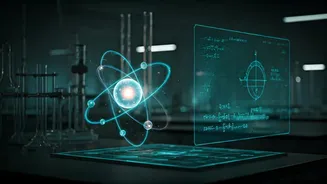
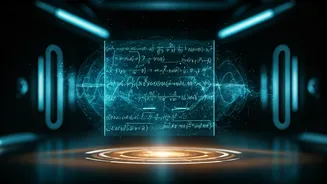
Physics is notoriously difficult because many of its core concepts—from quantum mechanics to Einstein’s theory of relativity—are impossible to see or experience in daily life. This is where AI-driven VR shines. Students can physically walk around a model of a carbon atom, watching electrons orbit the nucleus. They could manipulate magnetic field lines with their hands to truly understand how they work. Want to grasp special relativity? The simulation could let you ride a virtual train moving near the speed of light to witness time dilation and length contraction firsthand. These experiences transform abstract equations into intuitive, memorable moments, fostering a deeper understanding that textbooks alone often struggle to provide.
Personalised Learning on a Mass Scale
One of the biggest challenges in the Indian education system is the high student-to-teacher ratio. A single teacher cannot possibly give personalised attention to every student in a class of 40 or more. AI-powered VR offers a potential solution. The AI can assess a student's progress and adjust the difficulty. If a student masters a concept quickly, the AI can present them with more advanced problems. If they are struggling, the AI can break the concept down into simpler parts or offer a different visual explanation. This ensures that every student is learning at their own optimal pace, preventing brighter students from getting bored and helping struggling students catch up without feeling left behind. It's a way to democratise personalised tutoring.
Is This Happening in India?
While it's not yet a standard feature in every school, the foundation is being laid. The National Education Policy (NEP) 2020 explicitly encourages the integration of technology to improve learning outcomes. Premier institutions like the IITs in Bombay and Madras have established labs dedicated to exploring VR and AR (Augmented Reality). Several Indian ed-tech startups are also developing VR modules for subjects like physics, chemistry, and biology, primarily for K-12 students. Currently, these technologies are more common in specialised training sectors like medicine and engineering, but pilot programs are slowly making their way into mainstream education. The adoption is still in its infancy, but the intent and the technology are both present.
The Hurdles on the Road to Virtuality
The path to a VR-enabled classroom is not without its obstacles. The first and most significant is cost. High-quality VR headsets and the powerful computers needed to run them are expensive, making them inaccessible for most government schools and even many private institutions. Secondly, there's the issue of infrastructure—reliable, high-speed internet is a must for a seamless experience. Teacher training is another crucial factor; educators need to be equipped with the skills to integrate this new technology into their curriculum effectively. Finally, developing high-quality, pedagogically sound VR content is a massive undertaking. Without engaging and accurate educational software, the hardware is just an expensive toy.