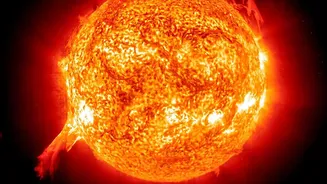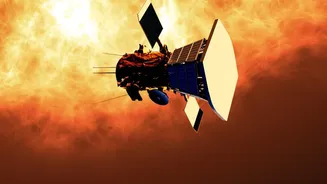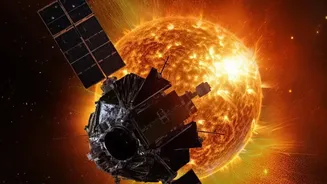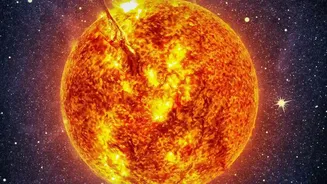

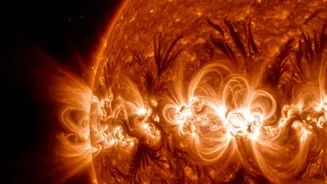
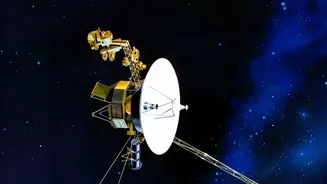
Two of the world’s most advanced solar observatories, India's Aditya-L1 and Europe's Proba-3, are teaming up. For the first time, scientists have combined their data to get a revolutionary, multi-layered view of the Sun's violent eruptions.
India's Unblinking Eye on the Sun
Launched by
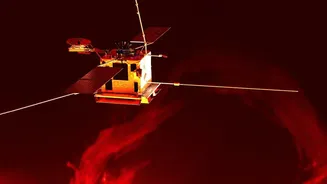
ISRO in September 2023, Aditya-L1 is India's first dedicated mission to study the Sun. It is strategically positioned at the Sun-Earth Lagrange Point 1 (L1), about 1.5 million kilometres from Earth, which gives it a continuous, uninterrupted view of our star. One of its seven key instruments is the Visible Emission Line Coronagraph (VELC). Developed by the Indian Institute of Astrophysics, the VELC is designed to observe the Sun's corona, its superheated outer atmosphere. Specifically, it conducts spectroscopic observations, which means it breaks down the light from the corona to analyse the temperature, density, and velocity of the plasma, especially during explosive events like coronal mass ejections (CMEs).
Europe's Artificial Eclipse in Space
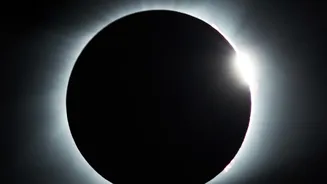
The European Space Agency's (ESA) Proba-3 mission, launched in December 2024 aboard an ISRO PSLV rocket, is a marvel of engineering. It is the world's first precision formation-flying mission, consisting of two separate spacecraft. The 'Occulter' spacecraft flies about 150 metres in front of the 'Coronagraph' spacecraft, precisely blocking the Sun's bright disc. This creates a long-lasting artificial solar eclipse, allowing its ASPIICS instrument to capture incredibly detailed images of the very faint inner corona, a region notoriously difficult to see against the Sun's glare. Where other coronagraphs are blinded by the Sun's brightness, Proba-3 can see the fine details of an eruption's origin point.
Two Views Are Better Than One
The power of this joint study lies in how these two different observation methods complement each other. Aditya-L1’s VELC provides spectroscopic data, giving scientists the physical properties of the erupting material, such as its temperature and density. Meanwhile, Proba-3’s ASPIICS provides sharp, clear images of the eruption's shape, structure, and movement. By combining the 'what' from VELC with the 'how it looks' from ASPIICS, researchers can build a far more complete and cross-checked picture of a solar event than either mission could achieve alone. A recent study published in 'Astronomy & Astrophysics' showcased this synergy by analysing two CMEs observed in September 2025.
Tracking Solar Storms from Birth
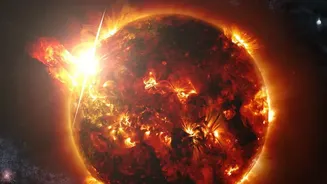
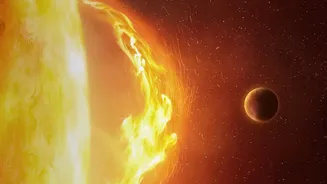
Coronal mass ejections are massive expulsions of plasma and magnetic fields from the Sun. When aimed at Earth, they can cause geomagnetic storms that threaten satellites, power grids, and communication networks. Understanding their early evolution is critical for predicting their impact. The joint study found that VELC on Aditya_L1 could spot the CMEs in their earliest stages, while ASPIICS provided high_resolution imagery as they developed. For example, the team tracked one fast CME travelling at about 645 km/s and a much slower one at 145 km/s, calculating their mass and energy with greater confidence because the two independent measurements agreed with each other. This provides new observational constraints on the physics that drives these powerful events.
A Landmark for International Collaboration
This research, led by scientists at Bengaluru's Indian Institute of Astrophysics with European and American partners, marks a significant moment for space science. It not only highlights the advanced capabilities of India's Aditya_L1 mission on a global stage but also demonstrates the immense scientific potential of coordinated international observations. The fact that Proba_3 was launched on an Indian rocket further cements this successful partnership between ISRO and ESA. This collaborative approach is setting a new standard for heliophysics, pooling resources and data to better understand our dynamic star and protect our technologically dependent world.