



A Rose-Colored Riddle in Space
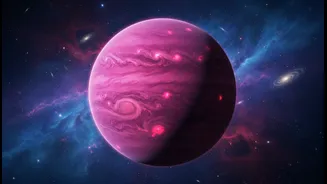
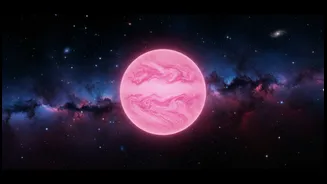
Discovered in 2013 using the Subaru Telescope in Hawaii, GJ 504 b orbits a sun-like star about 57 light-years away in the constellation Virgo. What immediately set it apart was its stunning color, described by NASA as reminiscent of a dark cherry blossom.
This isn't just a pretty face, however. The planet is a gas giant, estimated to be several times the mass of Jupiter, but what truly puzzles astronomers is its location. It orbits its star at a distance roughly 44 times greater than the Earth-Sun distance, a vast separation that defies our leading theories of planet formation. In our own solar system, even massive Jupiter is only about five times the Earth-Sun distance from its star. This remote placement makes GJ 504 b an outlier and a fascinating scientific puzzle.
The Formation Problem
So, how did this massive planet get so far out? That's the billion-dollar question. The most widely accepted model for giant planet formation is called core accretion. This theory suggests that planets form from the gas and dust in a disk rotating around a young star, growing bit by bit like a snowball. However, this model struggles to explain how a planet could form so far from its star, where the raw materials for planet-building are thought to be much scarcer. The distance of GJ 504 b poses a significant challenge to the core-accretion model, leading scientists to consider alternative theories, such as the idea that the planet may have formed through a rapid collapse of gas and dust—a process called gravitational instability. The very existence of GJ 504 b suggests our understanding of planetary birth is incomplete.
The Chemistry of a Pink Glow
The 'cool' in the headline is both literal and figurative. GJ 504 b is one of the coldest exoplanets ever to be directly imaged, with a temperature around 290 degrees Celsius—hot by Earth standards, but frigid for a young gas giant. Its famous pink or magenta hue is a result of this relative coolness and its youth. The planet is still glowing with the residual heat from its formation. The color we perceive is from this glow, filtered through its atmosphere. Recent observations from the James Webb Space Telescope have added a new layer of complexity. The data suggests the presence of water vapor, methane, carbon dioxide, and ammonia. Most surprisingly, to make the models match reality, scientists had to include clouds made of mineral salts like potassium chloride and zinc sulfide—a salty surprise that helps explain the planet's spectral fingerprint.
Is It Even a Planet?
The debate around GJ 504 b extends to its very classification. With a mass estimated to be around 25 times that of Jupiter, it sits on the blurry line that separates giant planets from brown dwarfs. Brown dwarfs are often called 'failed stars'—objects more massive than planets but not quite massive enough to ignite the sustained nuclear fusion that makes stars shine. Because of this ambiguity, many astronomers refer to GJ 504 b as a 'planetary-mass companion' rather than definitively calling it a planet. Whether it formed like a planet from the star's disk or like a star from a collapsing gas cloud is a question that remains unanswered. Its unusual, metal-rich atmosphere provides tentative clues pointing toward a planet-like formation but doesn't rule out a brown-dwarf origin.