



First, Let’s Define ‘Day’ and ‘Year’
Before we dive into the weirdness of Venus, let's get our basics straight using Earth as our guide. A ‘year’ is the time it takes a planet to complete one full orbit around the Sun. For Earth, that’s roughly 365 days. A ‘day’ is the time it takes a planet to complete one full rotation
on its own axis. For Earth, that’s about 24 hours. Simple enough, right? We experience hundreds of days within a single year. This relationship feels intuitive and normal to us. But in our solar system, ‘normal’ is a relative term, and Venus is the ultimate proof that the universe doesn't always play by the rules we're used to.
The Venusian Paradox Explained
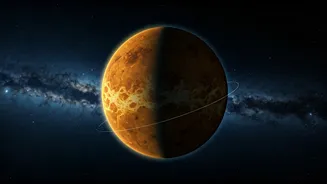
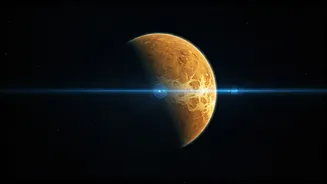
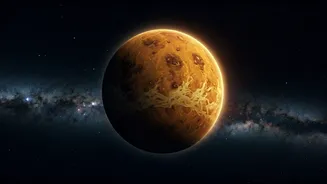
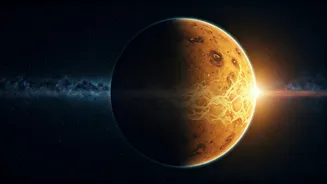
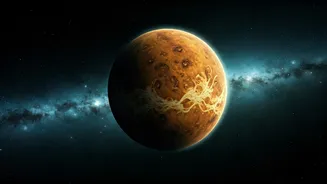
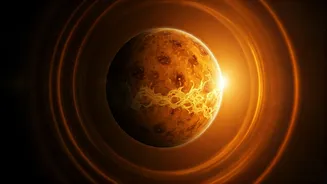
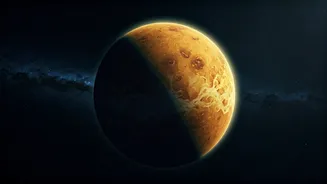
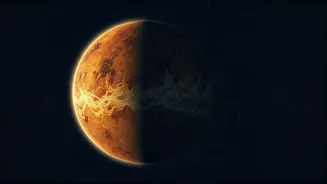
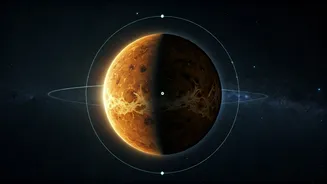
Here’s where your brain might start to ache a little. A year on Venus—the time it takes to circle the Sun—is approximately 225 Earth days. Now, for the mind-bending part: a single day on Venus—the time it takes for the planet to spin once on its axis—is approximately 243 Earth days. Let that sink in. It takes longer for Venus to complete one rotation than it does for it to complete an entire journey around the Sun. A Venusian day is about 18 Earth days longer than a Venusian year. This makes Venus unique in our solar system, a planet where the rhythm of time is unlike anything we know.
The Slow, Backward Spin
The primary reason for this temporal oddity is Venus's extremely slow and backward rotation. Most planets in our solar system, including Earth, spin on their axis in a counter-clockwise direction (prograde rotation). This is why our sun rises in the east and sets in the west. Venus, however, spins clockwise (retrograde rotation). It’s one of only two planets, along with Uranus, to do so. Not only does it spin backwards, but it spins incredibly slowly. While Earth zips around on its axis once every 24 hours, Venus takes a leisurely 243 Earth days to do the same. This sluggish, backward spin is the mechanical key to its day-year paradox.
But Wait, It Gets Weirder
Because of this strange combination of a 225-day orbit and a 243-day backward rotation, the concept of a ‘solar day’ (the time from one sunrise to the next) is different again. If you were standing on Venus, you'd see the sun rise in the west, creep slowly across the sky, and set in the east. The time between one sunrise and the next would be about 117 Earth days. So, while a rotational day is 243 Earth days, you’d only experience about two sunrises for every one trip around the Sun. You'd live through two long ‘day-night’ cycles in a single Venusian year.
Why Is Venus So Strange?
Scientists aren't 100% certain why Venus is such a cosmic outlier. The leading theory suggests that in the early, chaotic days of the solar system, a massive object—perhaps a planet-sized asteroid—slammed into Venus, effectively reversing its spin and slowing it down dramatically. Another theory points to its incredibly thick and heavy atmosphere. The dense blanket of carbon dioxide, which creates a runaway greenhouse effect and surface temperatures hot enough to melt lead, might be exerting such a strong atmospheric tide and friction on the surface that it has gradually slowed the planet's rotation over billions of years. It's possible a combination of these factors created the bizarre world we see today.