


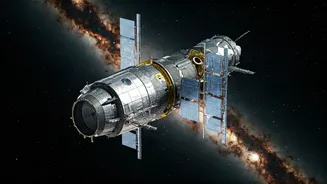


A Cosmic First Responder
For more than 20 years, the Neil Gehrels Swift Observatory has been NASA’s cosmic 'first responder'. Launched in 2004, its primary mission is to study gamma-ray bursts (GRBs), the most powerful explosions in the universe, which can signal the birth of
a black hole. True to its name, the Swift telescope can pivot with incredible speed to catch these fleeting events, giving astronomers precious data from phenomena billions of light-years away. Over its two decades of service, it has been wildly successful, detecting over 1,000 GRBs and contributing to a vast range of astronomical discoveries beyond its original mandate. But even the most reliable workhorse eventually faces an insurmountable problem.
The Inevitable Fall
The problem facing Swift is not a sudden malfunction, but the slow, relentless pull of gravity. The observatory lacks its own propulsion system to maintain its orbit. In recent years, this has become a critical issue. The Sun is currently near the peak of its 11-year cycle of activity, which has heated and expanded Earth's upper atmosphere. This expansion creates more drag on satellites in low-Earth orbit, acting like a brake that pulls them downward. Swift's orbit has been decaying faster than anticipated, and without intervention, it is projected to fall below a point of no return by October 2026, after which it would burn up upon re-entry. To buy more time, NASA powered down its science instruments in February 2026 to minimize drag.
The Robotic Tugboat Solution
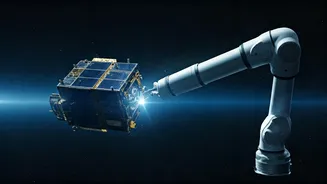
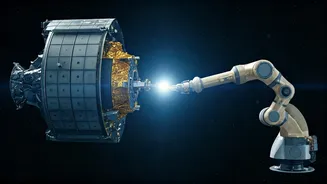
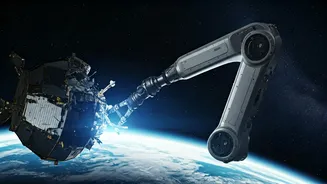
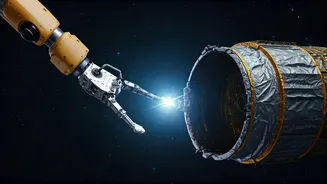
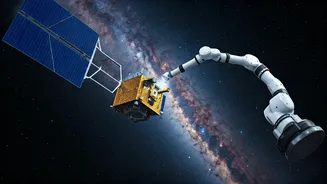
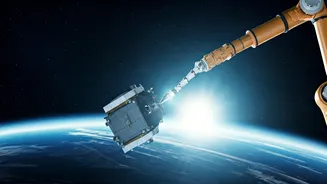
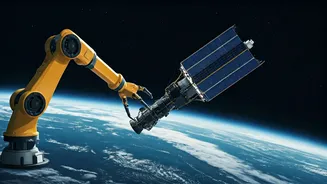
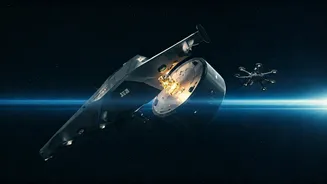
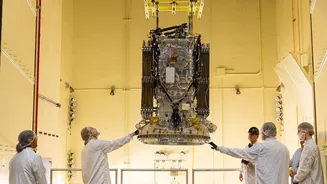
Since letting the valuable observatory be destroyed was not an ideal option, NASA opted for a plan straight out of science fiction. The agency awarded a $30 million contract to Katalyst Space Technologies, an Arizona-based startup, to build a robotic rescuer. The result is a spacecraft named LINK, a robotic 'tugboat' designed to perform a task never before attempted by an American spacecraft. Roughly the size of a small refrigerator, LINK is equipped with three robotic arms, each ending in a pincer-like gripper. The plan is for LINK to launch, chase down the Swift observatory, carefully grab onto it, and then use its own gentle ion thrusters to slowly push the combined pair into a higher, more stable orbit.
A High-Stakes Gamble
The entire mission is an extraordinary gamble, not just because it's a first-of-its-kind operation, but because of the timeline. Katalyst was given just nine months from the contract award in September 2025 to design, build, and prepare LINK for launch. This is an astonishingly rapid turnaround for a complex space robot. The challenge is magnified by the fact that Swift was never designed to be serviced, repaired, or grappled with in space. It has no docking ports or convenient handholds. The LINK robot will have to autonomously identify and secure a grip on the multi-ton observatory without damaging any of its sensitive components. Mission leaders have acknowledged it is a high-risk, high-reward effort, with no guarantee of success.
A New Playbook for Space
If successful, the 'Swift Boost' mission will do more than just add another decade of life to a beloved telescope. It will prove a new and vital capability: on-orbit servicing for satellites that were not designed for it. This could open the door to extending the lives of other critical and expensive space assets, from weather satellites to iconic observatories like the Hubble Space Telescope, which is also losing altitude. It represents a shift from a disposable model of space hardware to a more sustainable one where satellites can be repaired, refueled, and repositioned. The mission is currently facing launch delays due to technical issues with the Pegasus XL rocket that carries it, adding to the drama of this race against time.