





An Ambitious Encore Performance
The Hayabusa2 spacecraft is already a hero in the space exploration world. Its primary mission, which ended in 2020, successfully collected samples from the asteroid Ryugu and returned them to Earth for study. But JAXA, the Japan Aerospace Exploration
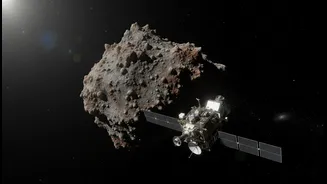
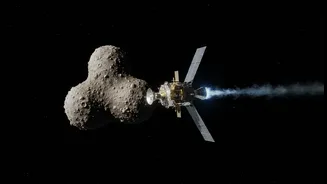
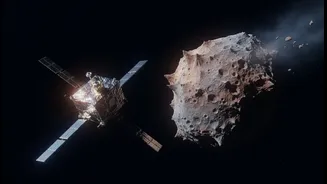
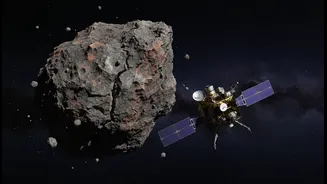
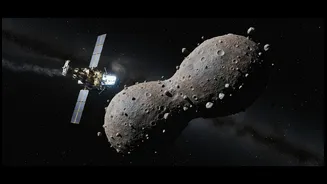
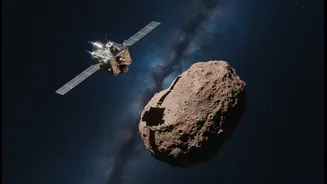
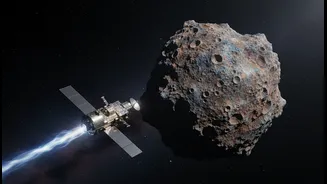
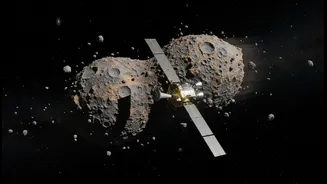
Agency, knew the probe still had fuel and life left in it. So, it was sent on an ambitious extended mission, dubbed Hayabusa2#. Its first major objective was a high-speed flyby of a new target: a 450-meter-wide, fast-spinning asteroid named Torifune (formerly 2001 CC21). The flyby, which occurred on July 5, 2026, was not just about getting a closer look at another space rock; it was a crucial test of deep-space navigation and planetary defense technologies.
The Challenge of Finding Your Way in the Dark
Navigating in deep space is nothing like using GPS on Earth. There are no satellites to triangulate your position. For decades, spacecraft have relied on communication with giant radio antennas on the ground, like NASA’s Deep Space Network, to figure out where they are and where they’re going. But this method has a built-in delay. Commands can take many minutes to travel from Earth to a spacecraft and back, making real-time control impossible. This is especially problematic for a high-speed flyby, where the entire encounter can be over in minutes. Any slight miscalculation in the asteroid's predicted orbit or the spacecraft's trajectory could lead to a missed opportunity or even a collision.
Seeing the Target with a Digital Eye
To overcome the time-lag problem, Hayabusa2 relied heavily on optical navigation. This technique involves using the spacecraft's own onboard cameras to take pictures of the target asteroid against the background of known stars. By analyzing the asteroid's position in these images, the spacecraft can determine its own location relative to the target with increasing accuracy as it gets closer. Because Torifune is a small, dark object, Hayabusa2 could only begin to see it a few days before the flyby, requiring rapid, last-minute trajectory calculations. This ability to self-navigate reduces the reliance on constant communication with Earth and allows for much greater precision in fast-paced maneuvers.
A Spacecraft That Thinks for Itself
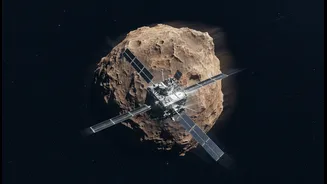
The Torifune flyby pushed this concept even further, demonstrating autonomous navigation. The spacecraft wasn't just seeing the target; it was using that visual data to make its own course corrections. This is a critical skill for future missions. The probe's systems were designed to automatically lock onto the asteroid, keeping it in the narrow field of view of its fixed cameras as it sped past at roughly 5 kilometers per second. This incredible feat of automation is what allowed JAXA to attempt such a close pass—coming within just a few kilometers of the asteroid—a maneuver that would be impossible with ground-based control.
Paving the Way for Planetary Defense
The lessons learned from this flyby extend far beyond this single mission. The demonstration of high-precision, autonomous guidance is a huge step forward for planetary defense. The same technology used to steer Hayabusa2 so close to Torifune could one day be used to guide a projectile—known as a kinetic impactor—to deliberately strike an asteroid that poses a threat to Earth, altering its course. JAXA officials noted that this successful maneuver demonstrates to the world that Japan possesses the core technology needed for such planetary defense efforts. After this encounter, Hayabusa2 will continue its journey, heading for a 2031 rendezvous with an even smaller, faster-spinning asteroid, 1998 KY26, further honing these vital capabilities.