
The Cosmic Middle Child
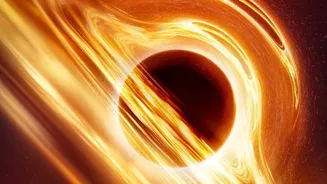
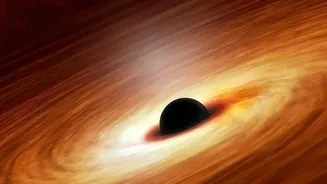
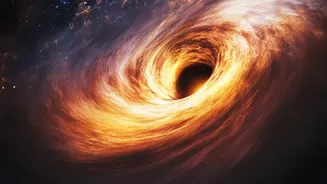
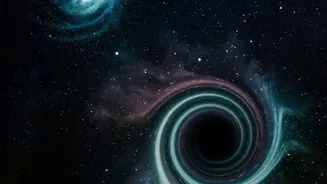
For decades, astronomers have observed two main types of black holes. There are stellar-mass black holes, typically 5 to 100 times the mass of our sun, which form from the collapse of massive stars. On the other end of the spectrum are the supermassive
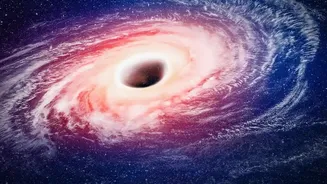
black holes, behemoths millions or even billions of times our sun's mass, that sit at the center of nearly every galaxy, including our own Milky Way. In between these two extremes, there was a glaring gap in the family portrait: the intermediate-mass black hole (IMBH). Weighing in at 100 to 100,000 solar masses, these objects were long theorized but notoriously difficult to find, earning them the nickname of the cosmic 'missing link'. Their existence is a crucial test for our understanding of how black holes grow.
A 'Chirp' Across the Universe
Detecting a black hole, an object from which not even light can escape, is challenging enough. Detecting two of them crashing into each other hundreds of millions of light-years away seems impossible. Yet, that is precisely what observatories like LIGO, Virgo, and KAGRA (LVK) are designed to do. When two massive objects like black holes spiral together and merge, they release an enormous amount of energy in the form of gravitational waves, which are ripples in the very fabric of spacetime. These waves travel across the universe at the speed of light. By the time they reach Earth, they are incredibly faint, but the LVK's hyper-sensitive laser interferometers can detect the minute stretching and squeezing of space they cause. The first direct detection in 2015 opened a new era of astronomy, allowing us to listen to the universe's most violent events.
Catching Giants in the Act
Recent observations have provided the most compelling evidence yet for these elusive IMBHs. The event GW190521 was a landmark, where two black holes merged to form a new one with a mass of about 142 times that of the sun, placing it squarely in the IMBH range. Another event detected in November 2023, GW231123, smashed even that record, producing a final black hole of around 225 solar masses from the merger of two already massive progenitors. What makes these discoveries particularly exciting is that the black holes involved are often too massive to have formed from a single star's collapse, a process which isn't thought to produce black holes between 65 and 120 solar masses. This suggests a different origin story, one of hierarchical merging, where black holes grow by repeatedly consuming each other.
Rewriting the Galactic Blueprint
The existence and merger of IMBHs directly impacts one of the biggest questions in cosmology: how do galaxies form? A central part of that puzzle is how supermassive black holes get so big. One theory proposed that they grew from enormous gas clouds in the early universe, while another suggested they started small and grew by steadily consuming stars and gas over billions of years. The discovery of IMBH mergers provides a compelling new pathway. These mid-sized black holes could be the 'seeds' that grow into supermassive ones. Simulations suggest that frequent mergers of IMBHs, especially in the dense, chaotic environments of the early universe or in the hearts of star clusters, could rapidly build up the mass needed to create the galactic giants we see today. This 'bottom-up' model, where smaller black holes merge to form bigger ones, is gaining significant traction thanks to the new gravitational wave data.