

The Sun's Violent Outbursts
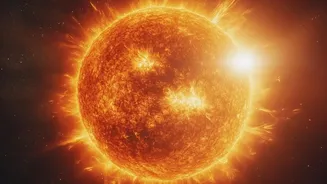
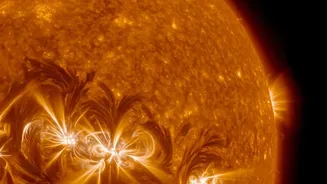
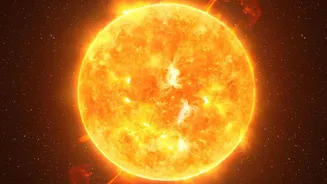
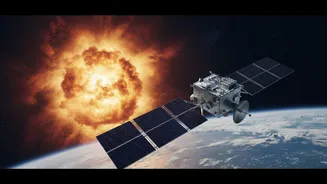
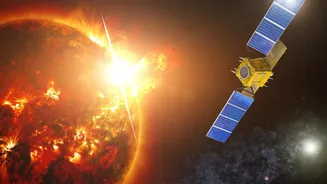
Our Sun might seem like a steady, benevolent star, but it has a violent temper. It frequently unleashes what are known as coronal mass ejections, or CMEs. Think of a CME as a colossal solar sneeze. These are enormous expulsions of plasma and magnetic
fields from the Sun's outer atmosphere, the corona. Billions of tons of solar material can be hurled into space at incredible speeds, ranging from under 250 to nearly 3,000 kilometers per second. While most CMEs drift harmlessly into the cosmos, the ones aimed at Earth pose a significant threat, capable of triggering powerful geomagnetic storms that can wreak havoc on technology.
Eyes on the Sun: The First Line of Defense
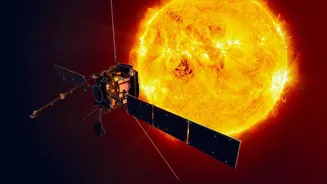
Predicting the impact of a CME begins with constant, vigilant observation of the Sun. This is the job of a fleet of specialized solar observatories. Spacecraft like the Solar and Heliospheric Observatory (SOHO), a joint NASA and European Space Agency mission, have been the workhorses of this effort for years. They carry instruments called coronagraphs, which create an artificial eclipse by blocking the Sun's blindingly bright disk. This allows forecasters to see the much fainter corona and spot CMEs as they erupt and expand outwards. By analyzing images from coronagraphs, experts can determine a CME's size, speed, and, most importantly, its direction.
Tracking the Threat Across Millions of Miles
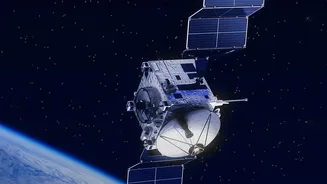
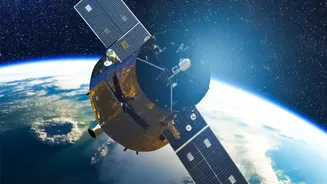
Once a potentially Earth-directed CME is identified, the race is on to forecast its arrival and potential severity. This is where organizations like the National Oceanic and Atmospheric Administration's (NOAA) Space Weather Prediction Center (SWPC) come in. Forecasters use the data from SOHO and other spacecraft, like NASA's STEREO-A, to run sophisticated computer models. These models simulate the CME's journey through space. A crucial piece of the puzzle comes from the Deep Space Climate Observatory (DSCOVR) satellite, which is strategically positioned about 1.6 million kilometers away from Earth at a point where the gravitational pulls of the Sun and Earth are balanced. By measuring the solar wind and magnetic fields as they pass, DSCOVR acts as a final tripwire, providing a critical 15 to 60-minute advance warning before the storm hits Earth.
From Forecast to Action: Safeguarding Our Orbiting Assets
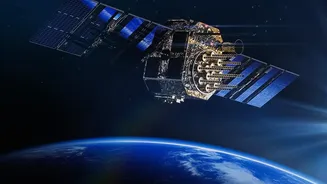
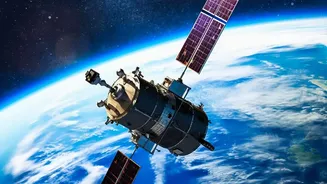
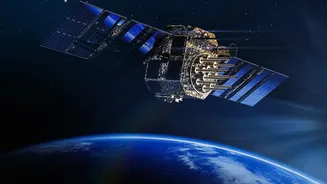
That final warning from DSCOVR is a crucial call to action for satellite operators. Geomagnetic storms can be incredibly harmful to spacecraft. The influx of high-energy particles can damage sensitive electronics, degrade solar panels, and even cause 'phantom commands' that disrupt operations. In more extreme cases, the storms heat and expand Earth's upper atmosphere, increasing drag on satellites in low-Earth orbit and potentially causing them to lose altitude. When an alert is issued, operators can take protective measures. This often involves putting vulnerable systems into a 'safe mode' to shield electronics from damaging currents or reorienting the spacecraft to protect its delicate components. For missions with astronauts, such as the International Space Station, this advance warning allows them to seek shelter in more heavily shielded parts of the station.
Why Space Weather Forecasting Is More Vital Than Ever
Our dependence on space technology is deeper than most people realize. GPS for navigation, global communications, financial transactions, and even weather forecasting all rely on a fleet of over 900 active satellites. A severe space weather event, like the historic Carrington Event of 1859, would be devastating in the modern era, potentially causing trillions of dollars in damage and widespread blackouts. As companies launch ever-larger constellations of satellites and humanity pushes further into space, the need for accurate and timely space weather forecasting only grows. New missions and improved models are constantly being developed to provide better predictions, ensuring we can protect our vital infrastructure from the Sun's powerful outbursts.