

A Hurricane Bigger Than India
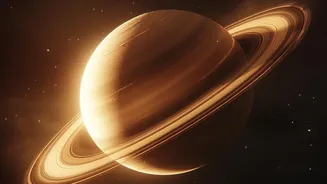
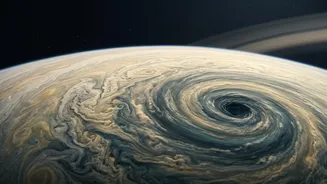
The most striking feature of Saturn's south pole is a gigantic, spinning vortex that looks remarkably like a hurricane on Earth. But its scale is almost unimaginable. This storm is a staggering 8,000 kilometres across, roughly two-thirds the diameter
of our entire planet. While it has a clearly defined central 'eye' and towering cloud walls just like a terrestrial hurricane, the similarities end there. Earth's hurricanes are fuelled by warm ocean water, a source Saturn completely lacks. This colossal storm is generated by forces within the planet's deep atmosphere, making it a fundamentally different and more mysterious kind of beast. Its winds whip around the eye at over 550 kilometres per hour, creating a weather system of terrifying power and endurance.
It Has a Bizarrely Warm Core
Here is where things get truly strange. Logically, a planet's poles should be its coldest regions, especially deep in the atmosphere. Yet, instruments have shown that the core of this south polar vortex is the warmest spot in Saturn's upper atmosphere. This is a perplexing discovery. While hurricanes on Earth also have warm cores, that heat is drawn up from the ocean. For Saturn's vortex, the heat seems to be coming from deep within the atmosphere, compressed and trapped by the swirling storm. This 'warm-core' anomaly turns our understanding of atmospheric physics upside down and suggests that complex, unknown processes are at work, making the vortex a self-heating engine in the coldest reaches of the planet.
The Storm That Never Moves
On Earth, hurricanes are notorious for their journeys. They form over the ocean and drift across vast distances, eventually dissipating over land or cooler waters. Saturn's south polar storm does nothing of the sort. It is permanently anchored to the planet's axis of rotation, locked directly over the pole. For years, scientists watched this vortex spin relentlessly in one place, a constant, churning fixture in the planet's climate. This lack of movement suggests it is not a temporary weather event but a fundamental feature of Saturn's atmospheric circulation, perhaps driven by the planet's rapid rotation and internal heat engine. It behaves less like a storm and more like a massive, planetary drain hole.
Its North Pole Has a Hexagon
Perhaps the strangest thing about the south pole's circular hurricane is what is happening at the other end of the planet. Saturn's north pole is home to one of the solar system's greatest marvels: a massive, six-sided jet stream known as 'the hexagon'. This perfectly symmetrical, 32,000-kilometre-wide weather pattern has baffled scientists since it was first seen. The fact that Saturn exhibits such a dramatic asymmetry—a circular vortex at one pole and a bizarre geometric shape at the other—is a major scientific puzzle. Why would the same planetary dynamics produce such wildly different results at opposite poles? This north-south divide hints at just how complex and unpredictable planetary atmospheres can be, and the answer is still eluding researchers.
An Eye Deeper Than Any on Earth
The 'eye' of this Saturnian storm is not just a visual curiosity; it is a window deep into the planet itself. The powerful dynamics of the vortex clear out the ammonia ice clouds that typically shroud Saturn, allowing us to peer into much deeper layers of its atmosphere. Scientists were able to see about 75 kilometres deeper than anywhere else on the planet. Furthermore, the clouds that form the 'eyewall' are themselves monstrous. They are towering structures, rising 30 to 75 kilometres above the surrounding cloud deck. This is two to five times taller than the cloud walls of the most powerful hurricanes on Earth. This three-dimensional structure provides clues about the storm's incredible power and the vertical forces at play within it.