





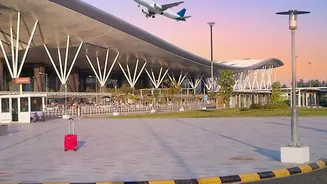


From 74 Airports to Over 250
The “100-Airport Plan” is the next phase of India’s ambitious Regional Connectivity Scheme, better known as UDAN (Ude Desh ka Aam Nagrik). Having already more than doubled the number of operational airports from 74 in 2014 to 166 today, the government
is now investing approximately ₹30,000 crore to build another 100 airports over the next decade. Announced as part of a Modified UDAN scheme set to run until 2036, the goal is to develop new airports from existing but currently unused airstrips, primarily in Tier-2, Tier-3, and remote regions. This isn't just about adding dots to the aviation map; it's a strategic effort to make flying a viable option for millions who have depended solely on long road or rail journeys.
The End of Time-Consuming Journeys
For travellers in smaller towns, the most immediate and tangible benefit is time. A journey that once took 12 hours by bus or train can now potentially be completed in a one-hour flight. This has been a game-changer for corporate travel, allowing businesses to expand into regional markets with greater efficiency. It has also transformed personal and leisure travel. Destinations that were once considered logistically difficult, like those in remote hilly states or island territories, are becoming more accessible. The plan effectively bridges the vast distances that have long defined travel between India’s heartland and its major economic centres, making it easier to visit family, attend events, or simply explore the country.
More Than Just Travel: A Local Economic Boost
The arrival of an airport acts as a powerful catalyst for local economies. Beyond the convenience for passengers, new air connectivity spurs growth in tourism, trade, and hospitality. Unexplored tourist destinations suddenly become viable, attracting investment in hotels and services. This, in turn, creates a wide range of jobs, from airport ground staff to local tour guides and small business owners. Proximity to an airport also drives real estate development, with new commercial and residential projects emerging in these newly connected zones. Each new airport, therefore, functions as a growth engine, creating a positive cycle of development and opportunity that extends far beyond the runway.
Affordability: The Core of the Plan
A key pillar of the UDAN scheme is making flights affordable. Under the program, a percentage of seats on designated regional routes are subject to a fare cap, often around ₹2,500 for a one-hour flight. This is made possible through Viability Gap Funding (VGF), a subsidy provided to airlines to compensate for operating on routes that may not initially be profitable. This cross-subsidy model, funded by a small levy on major air routes, is designed to democratise air travel. The goal is to bring flying within reach of a new segment of the population, shifting the perception of air travel from a luxury to a practical mode of transport.
Navigating the Turbulence: Challenges Ahead
Despite its successes, the journey hasn't been entirely smooth. A major challenge is ensuring the long-term sustainability of these regional routes. Past audits have shown that many routes ceased operations once the three-year government subsidy period ended, often due to low passenger demand or high operating costs for airlines. A 2023 report from the Comptroller and Auditor General (CAG) noted that out of 774 routes awarded in the early phases, a significant number did not commence or sustain operations. Furthermore, competition from improving road networks and new semi-high-speed trains like the Vande Bharat Express presents another challenge on shorter routes. The success of the 100-airport plan will depend not just on building infrastructure, but on ensuring these new connections are commercially viable for the long haul.