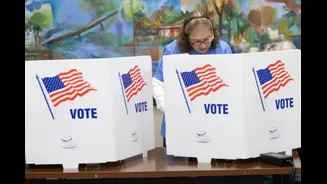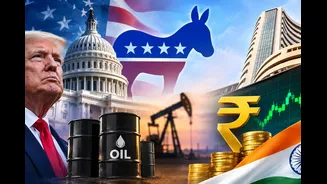







Money is the engine of modern politics, but how it flows into campaign coffers differs vastly across the globe. As the US navigates its election cycles, we examine how its rules on political contributions stack up against those in India.
Individual Donations: Caps vs. No Limits
In the United
States, the system is built around clear limits for individual donors. For the 2025-2026 election cycle, an individual can donate up to $3,500 per election (primary and general are separate) to a federal candidate. There are also annual limits on how much one can give to national party committees, currently set at $44,300 per year. These rules are enforced by the Federal Election Commission (FEC). India's approach is fundamentally different. While there are limits on how much a candidate can spend, there is no cap on how much an individual can donate to a political party. To claim a 100% tax deduction, however, donations must be made through non-cash methods like cheques or digital payments, and cash donations are limited. This creates a system where parties can receive unlimited funds from individuals, a stark contrast to the American model.
Corporate Money: Super PACs and Electoral Bonds
Corporate funding is where the two systems diverge dramatically. In the U.S., a landmark 2010 Supreme Court decision, Citizens United v. FEC, paved the way for Super PACs. These entities cannot donate directly to a candidate's campaign but can raise and spend unlimited amounts of money from corporations and unions to independently support or oppose candidates. This has led to a surge in outside spending in elections.
In India, corporate donations are also permitted. Recent amendments removed the previous cap on how much a company could donate (formerly 7.5% of average profits). A significant, though controversial, mechanism was the Electoral Bond scheme. Introduced in 2018, these bonds allowed individuals and corporations to donate money anonymously to political parties. However, in February 2024, India's Supreme Court struck down the scheme as unconstitutional, citing concerns about transparency.
The Foreign Funding Question
Both the United States and India have laws that strictly prohibit political contributions from foreign sources. In India, the Representation of the People Act, 1951, and the Foreign Contribution (Regulation) Act (FCRA) explicitly bar political parties from accepting foreign donations. Similarly, U.S. federal law bans contributions from foreign nationals in connection with any federal, state, or local election. However, amendments to India's FCRA have been a subject of debate, with some arguing they created loopholes for Indian companies with significant foreign investment to contribute, blurring the lines.
Transparency and Disclosure
On paper, the American system prioritizes transparency. The FEC maintains a public database where contributions to candidates, parties, and PACs are disclosed, allowing for public scrutiny of who is funding political campaigns. In India, while parties must file annual audited reports and disclose donations above a certain threshold, the now‐defunct electoral bond system was widely criticized for creating opacity, as the identity of the donor was not made public. This made it difficult to trace the link between a corporate donor and the receiving party, a key point in the Supreme Court's decision to strike the scheme down.
The regulatory bodies in each country have vastly different mandates. The U.S. Federal Election Commission (FEC) was established in 1975 with a narrow focus on enforcing federal campaign finance laws. It is a six‐member, bipartisan body, a structure that can sometimes lead to gridlock.
In contrast, the Election Commission of India (ECI) has a much broader constitutional mandate. Established in 1950, the ECI is responsible for the entire electoral process, from preparing voter rolls to conducting elections for parliament and state legislatures. While the FEC's role is confined to the money, the ECI is the overall referee for India's massive democratic exercise.