
The Great Chemical Puzzle
Before life as we know it could begin, a critical step had to occur: simple, non-living chemicals had to somehow assemble into complex organic molecules. These molecules—like amino acids, sugars, and the components of RNA and DNA—are the fundamental building
blocks of all living things. The immense challenge for astrobiology is explaining how this transition from simple geology and chemistry to complex biochemistry happened on the early Earth. This is often called the prebiotic chemistry gap. For decades, scientists have debated whether these crucial ingredients formed in Earth's primordial soup or if they were delivered from an extraterrestrial source. New evidence is tipping the scales toward the stars, suggesting Earth received a cosmic starter kit for life.
A Cosmic Delivery Service
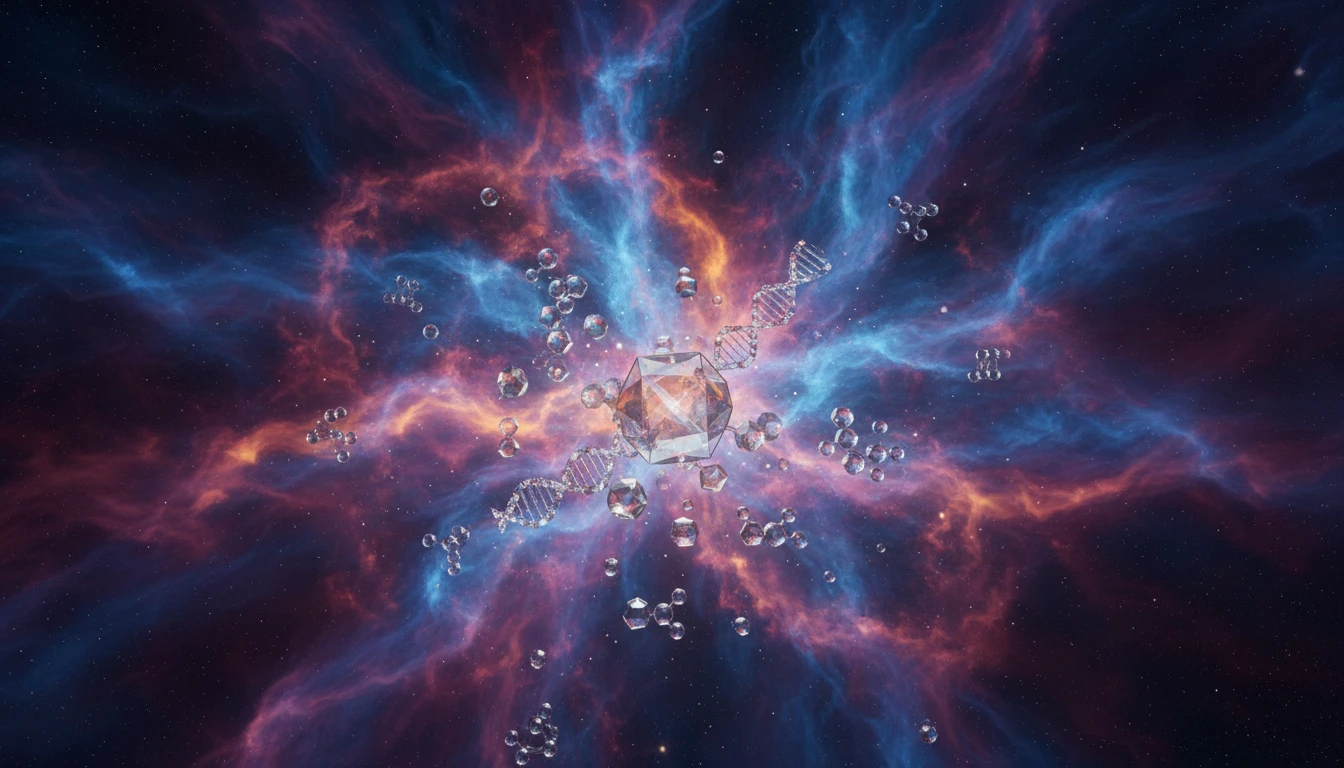
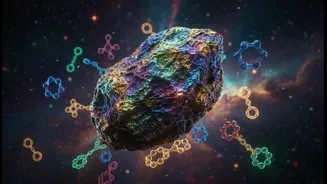
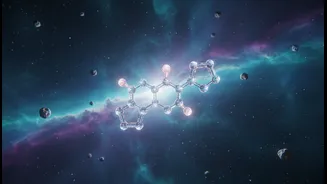
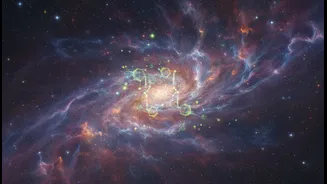
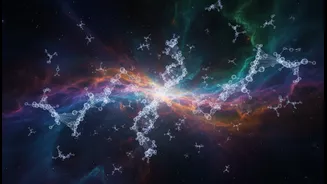
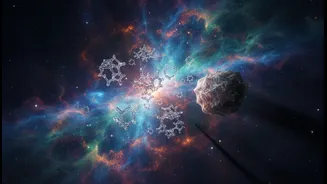
Interstellar space isn't empty. It's filled with vast clouds of gas and microscopic particles of dust, often no bigger than specks of smoke. These cosmic dust grains, typically made of silicates or carbon, are coated with a thin layer of ice composed of frozen water, methane, ammonia, and carbon monoxide. In the crushing cold of deep space, just a few degrees above absolute zero, these icy grains act as tiny, drifting chemical laboratories. Bombarded by ultraviolet radiation from nearby stars and cosmic rays, the simple frozen molecules on the dust grains break apart and recombine into more complex structures. Over millions of years, these specks of dust become rich with organic material, forming a reservoir of prebiotic molecules. The theory is that this enriched dust was then incorporated into comets and asteroids, which later crashed into the young Earth, seeding the planet with the ingredients necessary for life to emerge.
Recreating a Universe in a Bottle
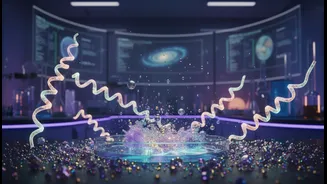
Testing this hypothesis requires bringing space down to Earth. Across the globe, scientists in laboratory astrophysics are simulating the harsh conditions of interstellar clouds inside highly controlled chambers. These are not your typical chemistry labs. They use ultra-high vacuum systems to replicate the near-emptiness of space and powerful cryogenic refrigerators to cool surfaces to as low as -267 degrees Celsius. Researchers then introduce a mix of simple gases and ices known to exist in space. Using particle accelerators or UV lamps, they irradiate these simulated cosmic ices to mimic millions of years of exposure to starlight and cosmic rays. By carefully analysing the residue left behind, they can discover what complex molecules form naturally in these extreme environments.
From Stardust to Life's Building Blocks
The results from these experiments are nothing short of astounding. Scientists at NASA's Goddard Space Flight Center have shown that irradiating these simulated ices reliably produces amino acids like glycine and alanine, the building blocks of proteins. Research teams have also successfully created formamide, a key precursor molecule that can lead to the formation of both genetic material and metabolic compounds. More recently, experiments at the University of Hawaiʻi at Mānoa managed to synthesise a whole suite of organic acids that are central to the Krebs cycle, a fundamental metabolic process that nearly all living organisms use to generate energy. These findings demonstrate that many of the essential components for life's core functions can be synthesised abiotically in space. They are not a fluke, but a natural consequence of chemistry in interstellar environments.