




The Perfect Vantage Point
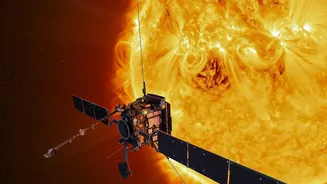
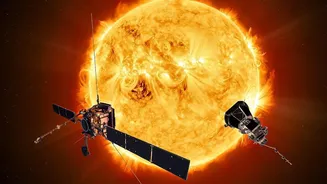
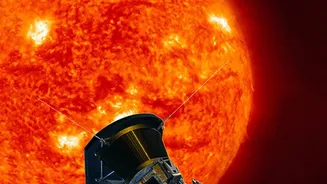
To track the Sun constantly, you need a very special parking spot in space. Aditya-L1 is positioned in a halo orbit around Lagrange Point 1, or L1. Think of L1 as a point of gravitational equilibrium, where the pull of the Sun and the Earth balance each
other out. This location, about 1.5 million km from Earth, allows the spacecraft to have a continuous, uninterrupted view of the Sun without any eclipses or occultations caused by the Earth or Moon. This is vital because solar phenomena can happen at any time. Being at L1 also means that solar storms, which are streams of energetic particles, reach the spacecraft about an hour before they reach Earth, giving us a precious head-start to prepare.
What Are Eruptive Phenomena?
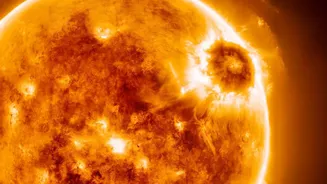
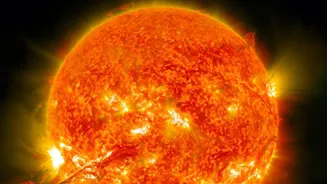
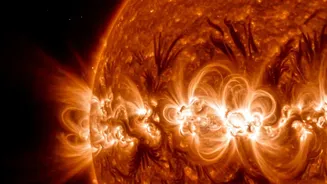
The Sun isn't always the calm ball of light it appears to be. It has a turbulent atmosphere that can produce massive explosions known as eruptive phenomena. The most significant of these are Coronal Mass Ejections (CMEs) and solar flares. A CME is a colossal eruption of plasma and magnetic fields from the Sun's outer atmosphere, the corona. Billions of tons of material can be hurled into space at speeds of over a million miles per hour. These events are the primary drivers of space weather, which can disrupt satellites, scramble communication and GPS signals, and even damage power grids on Earth. Aditya-L1's mission is to study these events from their origin to understand what triggers them and how they travel through space.
A Suite of Seven Watchful Eyes
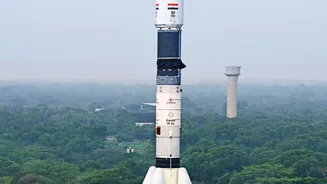
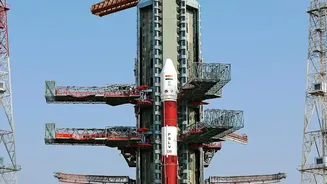
Aditya-L1 is equipped with seven indigenously developed payloads, each designed to study a different aspect of the Sun. These instruments act together as a comprehensive observatory. Four are remote-sensing payloads that observe the Sun's atmosphere, while three are in-situ payloads that measure the environment at the L1 point itself. This dual approach is critical; it’s like watching a cannon fire and then also being able to analyze the cannonball as it flies past. The remote instruments watch the explosion (the flare or CME) on the Sun, and the in-situ instruments study the ejected particles and magnetic fields (the solar wind) that arrive at L1.
Seeing the Unseen Corona
The star instrument for tracking CMEs is the Visible Emission Line Coronagraph (VELC). The Sun's disc is incredibly bright, which normally makes it impossible to see the much fainter corona around it. VELC acts like a permanent solar eclipse, using an internal system to block the direct sunlight. This allows it to continuously image the corona, which is where CMEs are born. By observing the corona in different wavelengths, VELC can detect changes in temperature, velocity, and density, providing the first visual clues that a massive ejection of plasma is underway. This is how Aditya-L1 can 'see' a CME begin and track its initial expansion and trajectory.
Sensing the Solar Wind
While VELC watches from afar, other instruments 'feel' the effects directly. The Aditya Solar wind Particle Experiment (ASPEX) and Plasma Analyser Package for Aditya (PAPA) are designed to study the solar wind—the stream of particles constantly flowing from the Sun. These instruments measure the composition, energy, and direction of solar wind particles like protons and electrons. When a CME or a high-speed solar wind stream passes the L1 point, ASPEX and PAPA detect a sudden change in particle density, speed, and temperature. Combined with data from the onboard Magnetometer (MAG) which measures the magnetic field, scientists get a complete profile of the incoming solar storm, allowing for more accurate space weather forecasts.