

The Universe’s Missing Mass
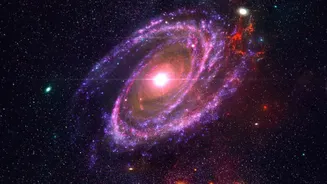
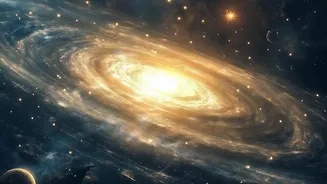
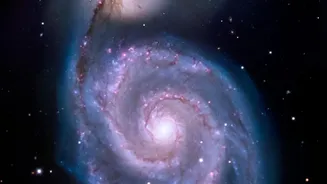
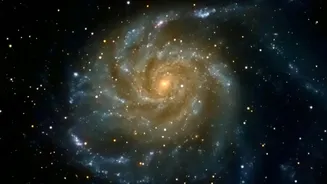
Our understanding of the cosmos has a huge hole in it, and scientists have called that hole ‘dark matter’. The puzzle began when astronomers noticed that galaxies were spinning so fast they should fly apart. Based on the visible stars and gas, there simply
wasn't enough gravity to hold them together. The leading solution, for nearly fifty years, has been to propose an invisible substance that doesn't emit or reflect light but has plenty of gravitational pull. This ‘cold dark matter’ (CDM) makes up about 85% of all matter in the universe and acts as an invisible cosmic scaffolding that holds galaxies together. This idea forms the basis of the standard model of cosmology, known as Lambda-CDM, which has been incredibly successful at explaining the large-scale structure of the universe.
An Alternative Idea: Modified Gravity
While dark matter became the mainstream explanation, a persistent alternative theory called Modified Newtonian Dynamics (MOND) has lingered since the 1980s. Proposed by physicist Mordehai Milgrom, MOND suggests there is no missing matter at all. Instead, Newton's law of gravity itself is incomplete. The theory posits that when gravitational acceleration becomes extremely weak, as it does in the outer regions of galaxies, gravity behaves differently, becoming stronger than Newton’s laws would predict. This elegantly explains why stars on the galactic fringes move so quickly without needing to invent a new substance. MOND has been remarkably good at predicting the rotation of individual galaxies, often with more precision than dark matter models.
MOND's Cosmological Problem
Despite its success on a galactic scale, MOND has long been sidelined because it failed on larger, cosmological scales. It couldn't explain the patterns seen in the Cosmic Microwave Background (CMB) — the faint afterglow of the Big Bang — or the large-scale distribution of galaxy clusters. The standard Lambda-CDM model, with its inclusion of dark matter, explains these large-scale observations beautifully. For MOND to be a true contender, it needed to be formulated in a 'relativistic' way, compatible with Einstein's theory of general relativity, and capable of explaining both the small and large-scale universe. For years, this seemed impossible, leaving MOND as a curious niche theory rather than a full-fledged replacement for dark matter.
A Mathematical Bridge Between Worlds
This is where the bold new model comes in. Physicists Constantinos Skordis and Tom Złośnik have developed a relativistic version of MOND (sometimes called RMOND) that finally seems to bridge this gap. Their work introduces new gravitational fields that behave differently in different environments. In the dense, high-acceleration environment of the early universe, their model generates a gravitational effect that perfectly mimics the presence of dark matter. This crucial feature allows it to reproduce the cosmological observations, like the CMB, that had long been MOND's downfall. However, in the low-acceleration environment of modern-day galaxies, the equations naturally simplify to produce MOND's modified gravity. It is the first framework that can successfully operate in both regimes, replicating the successes of the standard model at large scales and the successes of MOND at galactic scales.
A Debate Reopened
This mathematical breakthrough doesn't prove that MOND is right, but it places the theory on a much more equal footing with the standard dark matter model. For the first time, a modified gravity theory can explain observations across all cosmic scales. This development arrives at a critical time, as decades of expensive and sensitive experiments have failed to directly detect a single dark matter particle, leading to frustration and a willingness to explore alternatives. The work by Skordis and Złośnik has supercharged the debate, transforming MOND from a fringe idea into a viable contender. It suggests the solution to the universe's missing gravity might not lie in finding a new particle, but in achieving a deeper understanding of gravity itself.