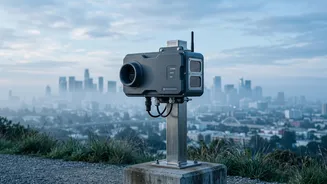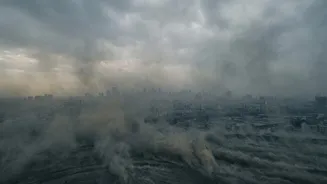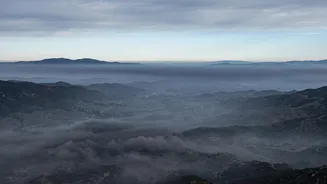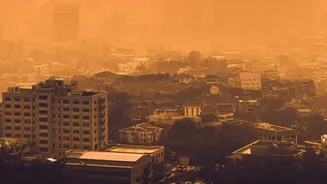




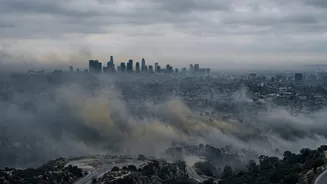
Ever wonder why the winter sky in many Indian cities fills with a thick, murky haze? It’s not just the pollution itself. A weather phenomenon called an atmospheric inversion acts like a lid, trapping harmful particles and making the air we breathe far
more dangerous.
An Invisible Lid in the Sky
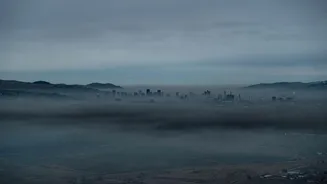
Under normal conditions, the air near the ground is warmer than the air above it. This warm air rises, carrying pollutants up and away, where they can disperse. An atmospheric inversion, also known as a thermal inversion, flips this pattern on its head. This typically happens on cold, calm nights, which are common in Indian winters. The ground cools rapidly, chilling the air closest to it. This results in a layer of cool, dense air being trapped beneath a layer of warmer air above. This warm upper layer acts like an invisible ceiling or a lid on a pot, preventing the vertical mixing of air. The air at ground level becomes stagnant, with nowhere to go.
What Is Particle Pollution?
The pollution trapped by these inversions is primarily 'particulate matter' (PM). This isn't a single substance but a mix of tiny solid and liquid particles suspended in the air. These particles come from sources like vehicle exhaust, industrial emissions, construction dust, and the seasonal burning of crop residue. Air quality reports focus on two main sizes: PM10 (particles 10 micrometres or smaller) and PM2.5 (2.5 micrometres or smaller). To put that in perspective, a single human hair is about 30 times wider than the largest PM2.5 particle. Because they are so small, these particles can be inhaled deep into our respiratory system.
The Multiplier Effect Explained
The term 'multiplier' is apt because the inversion doesn't create more pollution; it concentrates the existing pollution to dangerous levels. The same amount of emissions from traffic and industry that might disperse on a normal day gets trapped near the ground during an inversion. This trapping effect is particularly pronounced in India's Indo-Gangetic plains, where the Himalayan mountains to the north create a natural bowl that further restricts air movement. As the inversion persists, often for hours or even days, the concentration of PM2.5 and other pollutants builds up relentlessly. This is why air quality can plummet from 'moderate' to 'hazardous' overnight, even without a sudden increase in pollution sources.
The Alarming Impact on Our Health
This high concentration of fine particulate matter poses a severe health risk. The tiny PM2.5 particles are the most dangerous because they can penetrate deep into the lungs and even enter the bloodstream. Shortterm exposure can trigger coughing, shortness of breath, aggravated asthma, and increased hospital admissions for heart and lung issues. Longterm exposure is linked to more chronic problems, including an increased risk of heart attacks, strokes, lung cancer, and premature death, particularly in vulnerable groups like children, the elderly, and those with preexisting conditions. Hospitals in affected cities often report a surge in patients with respiratory distress during these severe pollution episodes.
How to Protect Yourself
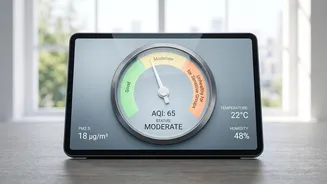
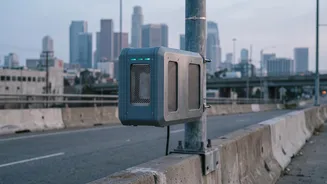
While we cannot control the weather, we can take steps to reduce our exposure during an inversion. The most crucial step is to stay aware of the daily Air Quality Index (AQI). On days when the AQI is high, it is best to limit time spent outdoors, especially strenuous activities like jogging. When you do go out, wearing a wellfitting mask like an N95 or KN95 can help filter out a significant portion of harmful particles. Indoors, using an air purifier with a HEPA filter can dramatically improve air quality. Weathersealing doors and windows can also help prevent polluted outdoor air from seeping into your home. Finally, individual actions like carpooling or using public transport can help reduce the overall amount of pollution that gets trapped in the first place.