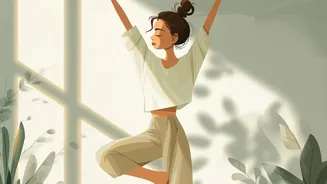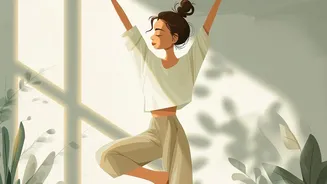



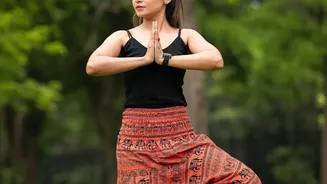
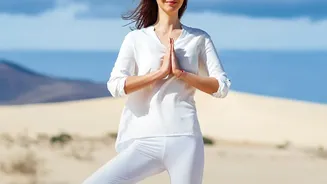
Known as Vrikshasana, Tree Pose is a foundational yoga posture that builds balance, strength, and focus. It looks simple, but this grounding pose is a powerful tool for finding stability, both physically and mentally.
Finding Your Roots: The Basic Tree Pose
Begin in Tadasana (Mountain Pose),
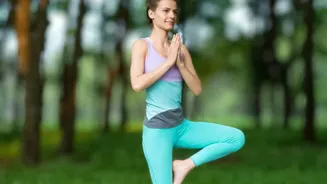
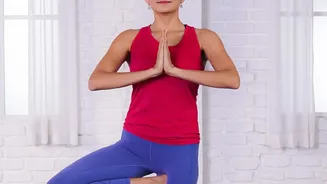
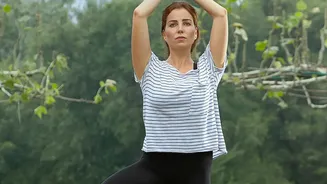
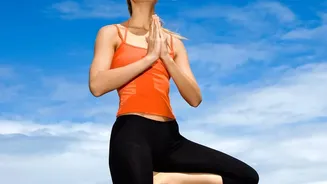
standing tall with your feet together or slightly apart and your arms at your sides. Distribute your weight evenly across both feet. Shift your weight onto your left foot, engaging the muscles of your standing leg. Bend your right knee and use your hand to guide the sole of your right foot to your inner left ankle, calf, or thigh. Crucially, avoid placing your foot directly on your knee joint, as this puts unsafe pressure on it. Press your foot firmly into your leg and your leg back into your foot to create stability. Keep your hips level and facing forward. You can bring your hands to a prayer position at your chest or extend them overhead like branches. Fix your gaze on a non-moving point in front of you (your 'drishti') to help maintain balance. Hold for 20-60 seconds, breathing steadily, before releasing and switching sides.
Beginner Variations for Stability
If balancing feels challenging, start with supportive variations. The goal is to build confidence without frustration. One of the best modifications is to use a wall or a sturdy chair for support. Simply stand beside your prop and rest a hand on it as you move into the pose. Another excellent option is the 'kickstand' variation. Instead of lifting your foot high, keep the toes of your bent leg on the floor and rest the heel against the inside of your standing ankle. This provides a wider base of support while still allowing you to practice the alignment of the pose, such as keeping the hips level and the standing leg engaged. You can also practice the pose while seated in a chair, which helps you focus on the upper body and hip-opening aspects without the balance challenge.
Intermediate Ways to Deepen Your Practice
Once you feel steady in the basic pose, you can explore variations that challenge your balance and concentration. One simple way to progress is by changing your arm position. Extending your arms overhead in a 'V' shape or out to the sides like a 'T' can slightly shift your center of gravity. Another powerful challenge is to introduce gentle movement. Try a 'windy tree' by slowly swaying your arms overhead while keeping your lower body stable. This forces your core and standing leg to make constant micro-adjustments. For an even greater challenge to your proprioception (your body's awareness in space), try briefly closing your eyes. Make sure a wall is nearby for support the first few times you try this, as it dramatically increases the difficulty.
Advanced Variations for a New Challenge
For experienced practitioners, advanced variations can transform Tree Pose into a deep hip opener or a test of strength. One popular progression is the Half-Lotus Tree Pose (Ardha Padmasana in Vrksasana). Here, you place the top of your foot onto the opposite hip crease, with the sole of the foot facing upward. This requires significant hip flexibility and should never be forced. Another option is to incorporate a side bend. From Tree Pose with your arms overhead, you can gently bend your torso to one side, creating an added balance challenge while stretching the side body. More dynamic variations include moving from Tree Pose into other standing balance postures, or even exploring inversions like Handstand with the legs in a Tree Pose configuration.
Essential Safety Tips for Practising at Home
Practising safely at home means listening to your body. First, always warm up with gentle movements to mobilize the spine and hips. When entering the pose, move slowly and deliberately. The most critical safety rule is to never place your foot directly on the side of your standing knee. Keep the standing knee strong but not locked; maintain a micro bend to protect the joint. It's also common to let the hip of the standing leg jut out to the side, but this bypasses the stabilizing muscles you're trying to build. Instead, engage your core and actively hug the muscles of the standing leg toward your midline. Ensure you have a clear space around you, and don't hesitate to use a wall for support. Finally, remember to breathe. If your breath becomes short or held, you may be pushing too hard.