


Seeing Beyond the Rainbow
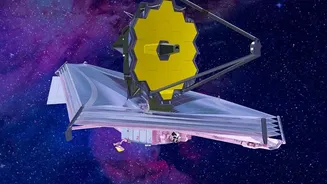
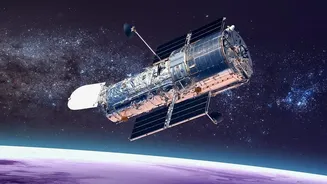
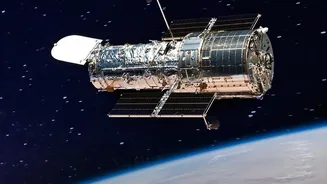
The key to studying these alien worlds is looking beyond the visible light our eyes can see. Enter infrared telescopes, like NASA's James Webb Space Telescope (JWST) and the now-retired Spitzer Space Telescope. Planets themselves are dim, but they glow
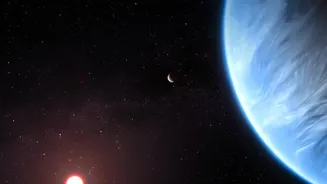
with heat, which is emitted as infrared light. By capturing this light, astronomers can detect these distant worlds and, more importantly, begin to understand what they're like. Infrared vision allows scientists to cut through the glare of a planet's parent star and measure the faint heat signature of the planet itself. This is the first step in creating a weather report for a world hundreds of light-years away.
Decoding Alien Atmospheres
So, how do you know if an atmosphere contains iron vapor or clouds made of quartz? Scientists use a clever technique called transit spectroscopy. As an exoplanet passes in front of its star from our point of view, a tiny fraction of the starlight filters through the planet's atmosphere. Different chemical elements and molecules absorb light at very specific infrared wavelengths. By analyzing which 'colors' of light are missing from the starlight that reaches the telescope, astronomers can identify the chemical fingerprint of the atmosphere. This method has revealed the presence of water, methane, carbon monoxide, and even silicates—the primary component of sand—in the atmospheres of distant gas giants.
A Forecast of Molten Iron
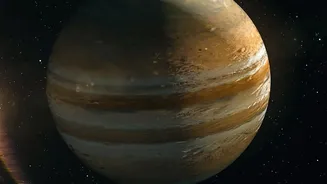
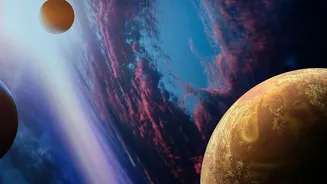
One of the most extreme weather forecasts is for the exoplanet WASP-76b, an 'ultra-hot Jupiter' located about 640 light-years away. This planet is tidally locked, meaning one side permanently faces its star. On this blistering 'dayside', temperatures soar to over 2,400 degrees Celsius, hot enough to vaporize metals like iron. Powerful winds, sometimes moving at thousands of miles per hour, then whip this iron vapor across to the cooler, permanent 'nightside'. There, the iron vapor cools, condenses into liquid droplets, and falls from the sky as a rain of molten iron. This incredible phenomenon was discovered by observing the planet's chemical signature as it rotated.
Charting a Planet's Climate
Beyond just identifying chemicals, telescopes like JWST can create actual weather maps. By observing a planet through its entire orbit, a technique called phase curve spectroscopy, scientists measure how the planet's brightness changes as different sides rotate into view. Since temperature is linked to brightness in the infrared spectrum, this data allows them to construct a map of temperatures across the planet's surface. This has been done for planets like WASP-43 b, revealing a scorching dayside, a cooler nightside covered in thick clouds, and powerful equatorial winds that move heat around the planet. These maps are our first real look at global climate patterns on worlds beyond our own solar system.