
The Gravitational Bullies
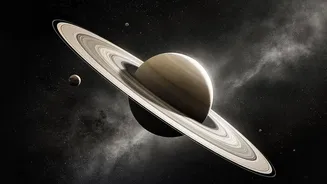
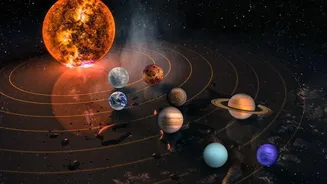
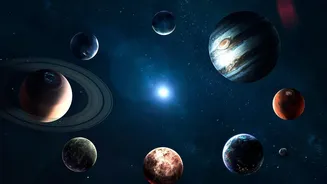
Jupiter and Saturn are unimaginably massive. Jupiter alone is more than twice as massive as all the other planets combined. This gives them immense gravitational influence, making them the primary architects—and potential wrecking balls—of the solar system.
Their pull dictates the paths of asteroids, comets, and even other planets. While their direct gravitational effect on Earth at any given moment is minuscule compared to the Sun's, their long-term influence has profoundly shaped our cosmic neighborhood. Over millions and billions of years, these tiny nudges can add up, determining the fine line between a stable, life-bearing system and a chaotic mess of colliding worlds.
A Violent, Wandering Youth
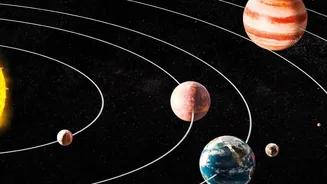
Planetary scientists believe the solar system's early days were far from orderly. Leading theories, such as the 'Nice Model' and the 'Grand Tack hypothesis', suggest the giant planets formed in a much more compact arrangement. According to the Grand Tack model, Jupiter migrated inward from its birthplace, moving as close to the Sun as Mars's current orbit, before being pulled back out by the gravitational influence of a newly formed Saturn. This colossal 'tack' maneuver, like a sailboat changing direction, would have wreaked havoc on the inner solar system, potentially explaining why Mars is so small and clearing out material that might have otherwise formed other planets.
An Unstable Dance of Resonance
Following this early migration, the Nice Model proposes that the giant planets fell into a period of instability. A key moment occurred when Jupiter and Saturn entered a 2:1 orbital resonance, where Jupiter completed two orbits for every one of Saturn's. This regular, repeating gravitational kick destabilized the entire system. Uranus and Neptune were flung into the far outer solar system, scattering a primordial disk of icy bodies. This event is thought to be responsible for the Late Heavy Bombardment, a period about 4 billion years ago when asteroids and comets rained down on the inner planets, as well as for the current structure of the Kuiper Belt and the distant Oort Cloud. Some models even suggest the solar system began with a fifth giant planet that was ejected entirely during this chaotic dance.
A Precariously Balanced Future
So, are we safe now? For human timescales, absolutely. The solar system is stable. However, looking billions of years into the future, the picture becomes fuzzy. The solar system is a technically chaotic system, meaning tiny variations in present conditions can lead to wildly different outcomes over immense timeframes. Long-term simulations show there is about a 1% chance that Mercury's orbit could become highly erratic over the next few billion years, potentially causing it to collide with Venus or be ejected from the solar system entirely. This instability is driven by the very same gravitational whispers from Jupiter and Saturn that once shaped the system. Even passing stars, hundreds of billions of years from now, could perturb Neptune's orbit just enough to amplify these effects and increase the chances of instability.