

A World of Crushing Pressure
The single greatest barrier to exploring the deep ocean is the immense, bone-crushing pressure. At the bottom of the Mariana Trench, the deepest known point, the pressure is over 1,000 times greater than at the surface. This is equivalent to having 50
jumbo jets stacked on top of you. These extreme conditions make direct human exploration nearly impossible and pose enormous engineering challenges for robotic vehicles. Remotely operated vehicles (ROVs) and autonomous underwater vehicles (AUVs) must be built with incredibly resilient materials, like titanium alloys, just to survive the descent. Furthermore, the environment is one of total darkness, near-freezing temperatures, and corrosive saltwater that degrades equipment over time. Even communicating with these robots is a struggle, as radio waves don't travel well through water, often requiring a physical tether to a ship or complex autonomous navigation systems.
What Creatures Live in the Dark?
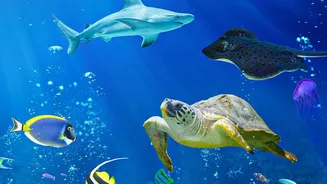
Scientists estimate that of the 2.2 million species believed to exist in our oceans, we have only described about 10%. A vast, unknown world of biodiversity is hidden in the depths. Every expedition into the deep sea brings back new discoveries, from bizarre-looking fish with their own built-in lures to entire ecosystems of creatures that thrive without sunlight around hydrothermal vents. Recent census efforts have identified over a thousand previously unknown species in a single year, highlighting how much is left to find. A major question is simply: what is down there? Many of these organisms are incredibly fragile and adapted to high-pressure environments, making it difficult to bring them to the surface for study. New robotic technologies are being developed to perform DNA sequencing and 3D imaging on-site, deep below the surface, to better understand this hidden web of life.
The Ocean's Role in Our Climate
The deep ocean is a critical player in regulating the Earth's climate, acting as a massive sink that absorbs enormous amounts of heat and carbon dioxide from the atmosphere. However, the exact mechanics of this process are still being uncovered. A major set of questions revolves around the 'global conveyor belt', a system of deep-ocean currents that circulates water around the planet. This circulation transports heat, carbon, and nutrients, but scientists are concerned that climate change and melting polar ice could slow it down. A recent study found that deep-ocean turbulence affects our climate on the scale of a human lifetime, much faster than previously thought, influencing everything from sea-level rise to the health of fisheries. Understanding these dynamics is crucial for building accurate climate models and predicting future changes.
Secrets of the Seafloor
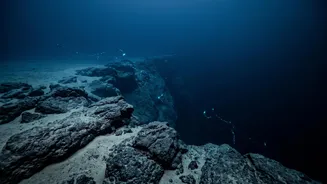
The ocean floor itself is a geological frontier. Less than a quarter of the world's seabed has been mapped with modern, high-resolution technology. It holds the keys to understanding fundamental planetary processes, like the movement of tectonic plates and the formation of volcanoes. Hydrothermal vents, which spew superheated, mineral-rich water, not only support unique life forms but may also offer clues about the origin of life on Earth. Exploring these geological features is a monumental task, akin to mapping an entire continent in total darkness. Advanced sonar, LiDAR, and autonomous mapping vehicles are slowly piecing together this underwater landscape, but the sheer scale of the ocean means it will take decades to complete the picture.
Our Hidden Human Footprint
A more recent and urgent set of questions relates to our own impact on this remote environment. Unfortunately, the deep sea is no longer pristine. Scientists have found plastic bags in the Mariana Trench, the deepest part of the ocean, and other pollutants like microplastics, chemical waste, and discarded fishing gear are now common. Researchers are racing to understand how these pollutants, along with the effects of ocean warming and acidification, are affecting deep-sea ecosystems. Destructive practices like deep-sea trawling and the potential for deep-sea mining pose further threats to fragile habitats we are only just beginning to understand. A key question is no longer just what is in the deep sea, but how we can protect it from the damage already being done.