


A Cosmic Delivery Service
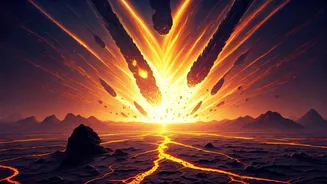
Think of early Earth, over 4 billion years ago. It was a hot, volcanic, and largely inhospitable planet. While it had the basic geological stage, it may have been missing some crucial ingredients needed for life to spark into existence. This is where
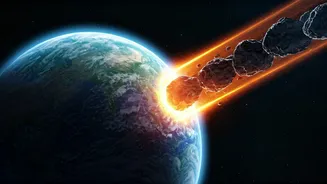
asteroids enter the story. The prevailing scientific image of asteroids is often one of destruction—after all, one is famously blamed for wiping out the dinosaurs. But a growing body of evidence supports a different role: that of a cosmic delivery service. The theory, known as 'exogenous delivery,' proposes that asteroids and comets bombarding the young Earth delivered the complex organic molecules that were the essential precursors to life.
What's in the Box?
So, what exactly did these celestial packages contain? Not living organisms, but something just as important: the building blocks of life. Scientists have discovered a treasure trove of vital compounds inside meteorites (asteroids that have landed on Earth). These include amino acids, which are the molecules that chain together to form proteins—the workhorses of our cells, responsible for everything from building tissues to catalysing chemical reactions. They also carried nucleobases, which are the fundamental units of our genetic code in DNA and RNA. It’s like a construction site getting a delivery of bricks and mortar; you still need to build the house, but now you have the materials.
From Ingredients to a Recipe
Having the ingredients is one thing; getting them to cook up into life is another. The early Earth provided the perfect, albeit chaotic, kitchen. When these asteroids crashed, they delivered their precious organic cargo into the planet's warm, watery environments, like hydrothermal vents or shallow ponds. These 'primordial soups' were likely bubbling with chemical energy. The presence of these asteroid-delivered molecules would have dramatically increased the chances of them reacting, linking up, and forming more complex structures. Over millions of years, this process could have led to the first self-replicating molecules—a critical step on the road to the first living cells.
The Evidence in Our Hands
This isn't just a neat theory; it's backed by concrete evidence. In 1969, a meteorite landed in Murchison, Australia, and was found to contain over 100 different amino acids, many of which are not common on Earth. This proved that these molecules could form in space and survive a fiery entry to our planet. More recently, the game-changing results from Japan's Hayabusa2 mission have provided even stronger proof. The spacecraft collected samples directly from the asteroid Ryugu and returned them to Earth. Analysis revealed not only amino acids but also uracil—one of the four bases that make up RNA. Finding this delicate molecule in a pristine sample, untouched by Earthly contamination, is a massive boost for the theory that the cosmos seeded our world with the stuff of life.
Not Just Any Asteroid
The type of asteroid matters. The most likely candidates for this cosmic delivery are known as carbonaceous chondrites. These are ancient, carbon-rich asteroids that are essentially frozen relics from the formation of our solar system. Because they formed in the cold outer regions of the system, they were able to preserve water and delicate organic compounds that would have been destroyed closer to the sun. They act as time capsules, giving us a direct look at the chemical inventory of the early solar system and providing a plausible source for the organic molecules that now make up every living thing on our planet.