






A Groundbreaking Glimpse
The latest breakthrough comes from a super-Earth named 55 Cancri e, located 41 light-years from us. While this isn't the first time scientists have studied this fascinating planet, the JWST has offered an unparalleled view. Researchers have detected atmospheric
gases surrounding this rocky world, a feat that has remained elusive until now. For years, thinner atmospheres on rocky planets have been difficult to confirm, but the JWST is pushing the boundaries of exoplanet characterization, opening a new frontier in science.
What Exactly is a Super-Earth?
The term 'super-Earth' might conjure images of a bigger, better version of our own planet, but it's really a size classification. These are exoplanets with a mass higher than Earth's but significantly less than that of our solar system's ice giants, like Neptune. They can be made of rock, gas, or a combination, and they are surprisingly common throughout our galaxy, even though our solar system doesn't have one. 55 Cancri e, for example, has a diameter nearly twice that of Earth and is slightly denser, fitting the profile of a rocky world much larger than our own.
How Webb 'Sees' an Atmosphere
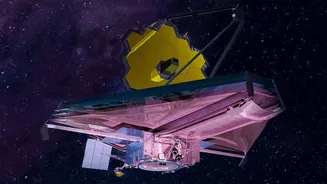
Detecting an atmosphere from 41 light-years away sounds like science fiction, but it's possible through a technique called transmission spectroscopy. When an exoplanet passes in front of its host star, starlight filters through the planet's atmosphere. Different gases absorb different wavelengths, or colors, of light. The JWST's powerful spectrographs can analyze the starlight that reaches us and identify the 'missing' colors, creating a chemical fingerprint of the planet's atmosphere. For 55 Cancri e, scientists also measured its thermal emission—the heat it gives off. The data showed a dayside temperature cooler than expected for a bare rock planet, suggesting an atmosphere is distributing heat from the day side to the night side.
Not Water, But a Hint of What's Possible
While early studies of 55 Cancri e hinted at an atmosphere rich in volatiles like oxygen and carbon dioxide, the new JWST data suggests it could be a secondary atmosphere. The planet orbits its star so closely that its surface is likely a molten ocean of magma. Researchers believe the detected gases, potentially carbon monoxide or carbon dioxide, are likely being vented from this magma ocean. This is different from the detection of water vapor on other, cooler planets like GJ 1214 b, which may be a 'water world'. For 55 Cancri e, the presence of any atmosphere at all is remarkable given its scorching temperature of around 1540 degrees Celsius. It's far too hot to be habitable or to have liquid water.
The Broader Search for Habitability
Finding an atmosphere on a rocky planet is a landmark achievement, even if this specific world is a hellish landscape. It's a crucial proof of concept, showing that the JWST can detect the very thing that makes life possible on Earth. The search for habitability isn't just about finding water; it's about finding rocky planets in the 'habitable zone'—the right distance from a star for liquid water to exist—that also possess a stable atmosphere. This discovery on 55 Cancri e, while not a habitable world itself, provides vital clues about the evolution of rocky planets, including how they might form and retain atmospheres. It helps scientists understand the early conditions that might have existed on planets like Earth, Venus, and Mars.